


Are lifepo4 batteries safe?
In our battery lab, we often see the same worry: lithium sounds risky, so buyers assume every lithium pack behaves the same.
LiFePO4 batteries are widely considered one of the safest mainstream lithium battery chemistries because their iron-phosphate structure is thermally stable and less prone to thermal runaway than nickel- and cobalt-based cells. They are not risk-free, so safe results still depend on BMS protection, correct charging, and proper installation.
That is why this topic matters so much in solar, RV, and backup power. The chemistry helps, but the full system decides the outcome.
What Is a LiFePO4 (LFP) Battery?
On our production line, we often find that confusion starts with the word “lithium,” because not every lithium battery uses the same chemistry.
A LiFePO4 battery is a lithium-ion battery that uses lithium iron phosphate as the cathode material. It stores and releases energy like other lithium batteries, but its chemistry is more stable, which is why it is widely used in solar storage, RV power, and industrial battery systems.
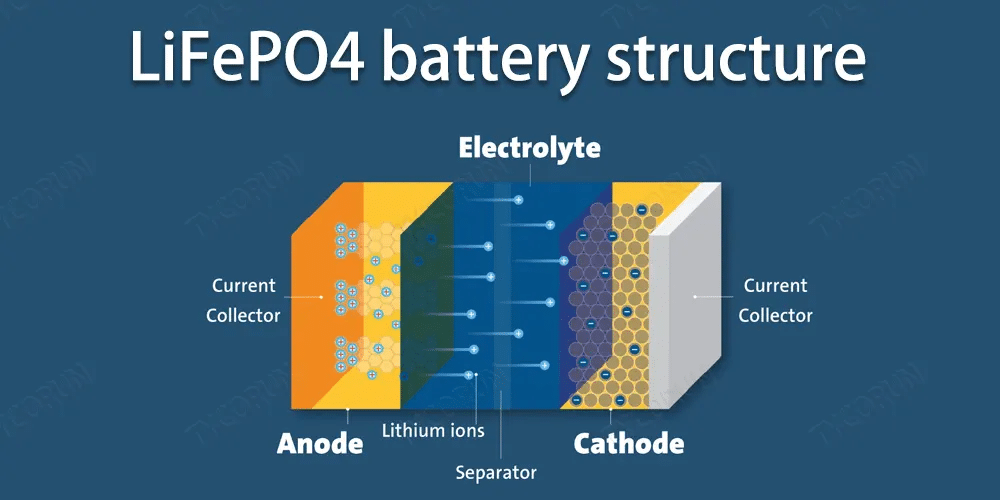
LFP in simple terms
LiFePO4 is usually shortened to LFP. It belongs to the lithium-ion family, but it is not the same as the nickel-rich chemistries used in many EVs and consumer products. That difference matters.
Inside a typical LFP cell, lithium ions move between the cathode and anode during charging and discharging. The chemistry is still powerful and efficient. But the iron-phosphate cathode is more stable under stress than many cobalt- or nickel-based options.
For solar professionals, this matters because battery safety is never only about energy density. It is also about how a cell behaves when something goes wrong. In stationary storage, off-grid sites, telecom backup, and RV systems, system owners often value stability, cycle life, and safety over the smallest possible size.
Why solar uses LFP so often
In solar work, we usually care about a few practical things:
- repeatable daily cycling
- stable operation over years
- lower fire propagation risk
- easier indoor or near-building deployment
- better fit for backup and self-consumption systems
That is why LiFePO4 is now common in residential storage, C&I backup, off-grid cabins, portable power stations, and DC battery banks. The user note is right: compared with ternary lithium materials such as NMC, LFP is much more stable, so it has become a mainstream safety-first choice in PV.
Chemistry safety vs system safety
This is the first important decision rule: a safer chemistry does not automatically create a safe battery system.
A LiFePO4 pack still includes:
- cells
- busbars
- interconnects
- BMS
- enclosure
- terminals
- fuses or breakers
- charger or inverter-charger
- communication and control logic
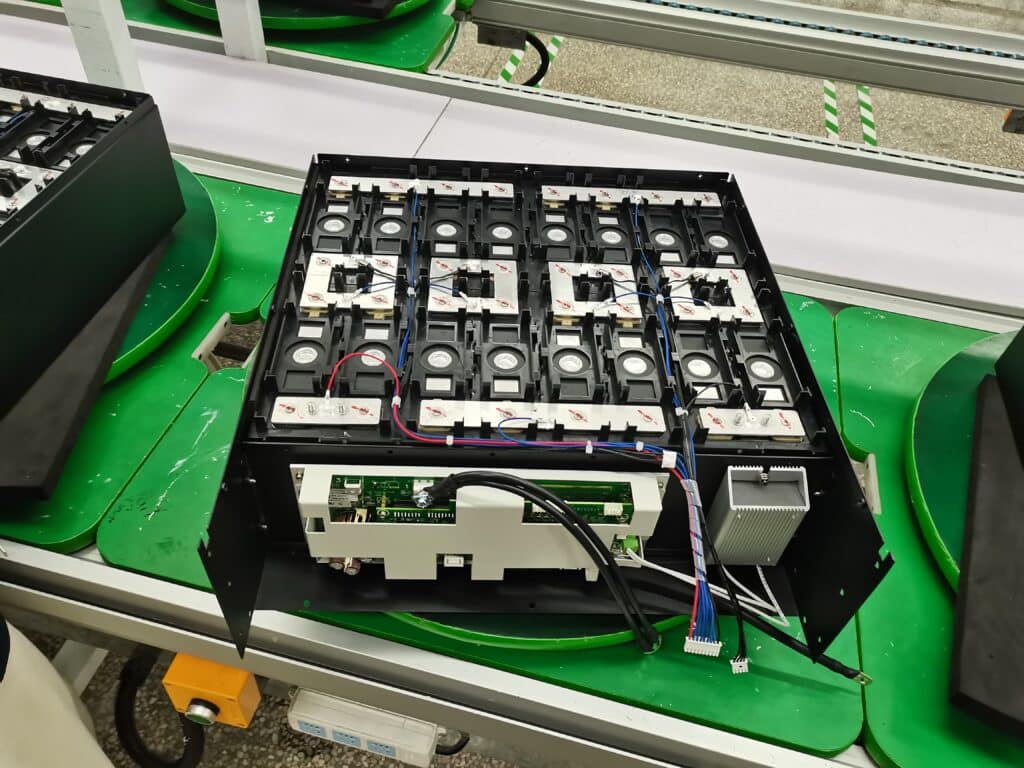
A strong chemistry can still be put into a weak pack. That is why you should evaluate both the cell chemistry and the full system design.
| Part of the battery system | What it does | Safety impact |
|---|---|---|
| LFP cells | Store energy | Safer chemistry baseline |
| BMS | Monitors and protects cells | Prevents misuse and dangerous drift |
| Wiring and terminals | Carry current | Bad sizing or loose torque can overheat |
| Fuse/contactor | Interrupts fault current | Limits damage during faults |
| Enclosure | Protects pack | Affects venting, spacing, and heat build-up |
| Charger/inverter settings | Control charging | Wrong settings can create overcharge risk |
لماذا LiFePO4 Is Considered Safer Than Other Lithium-Ion Batteries
In our abuse tests, we focus less on marketing claims and more on how a cell behaves when voltage, heat, or handling goes wrong.
LiFePO4 is considered safer than many lithium-ion chemistries because its iron-phosphate cathode is more chemically and thermally stable, and it is less likely to release oxygen during overheating. That lowers the chance of rapid self-feeding thermal events compared with many nickel- and cobalt-based batteries.
The chemistry advantage
The main reason LFP has a safety reputation is the cathode material. Iron phosphate is structurally stable. When overheated or damaged, it does not readily release oxygen the way some higher-energy chemistries can. That matters because oxygen release can feed fire behavior inside a failing cell.
So the question is not whether an LFP battery can ever fail. It can. The question is how aggressively the chemistry contributes to a failure once one starts. In many cases, LFP is less likely to escalate into a severe thermal event than chemistries designed for maximum energy density.
Abuse tolerance in real use
Many installers and distributors also prefer LFP because it is more forgiving in real-world handling. Compared with some other lithium-ion types, good LFP packs often show better resilience to:
- moderate overcharge or over-discharge events
- mechanical shock and vibration
- repeated cycling in solar storage
- operating stress in RV and marine environments
That does not mean you should test the limits. It means there is a wider safety margin when the system is designed correctly.
Safety vs energy density
Every chemistry brings trade-offs. LFP usually gives up some energy density in exchange for stability, cycle life, and lower risk. NMC and similar chemistries are often chosen where compact size and lower weight matter more, such as certain EV or space-constrained designs.
For solar and stationary storage, that trade-off often works in LFP’s favor. Extra cabinet space is usually easier to solve than extra fire risk.
| Chemistry | Thermal stability | Energy density | Abuse tolerance | Common use case | Key safety note |
|---|---|---|---|---|---|
| LiFePO4 (LFP) | High | Moderate | Strong | Solar storage, RV, backup power | Safety-forward choice when space is available |
| NMC | Moderate | High | Lower than LFP | EVs, compact storage | Higher energy density, but needs tighter controls |
| NCA | Moderate | High | Lower than LFP | High-performance mobility | Strong performance, but less forgiving |
| Lead-acid | Non-lithium | Low | Familiar but heavy | Legacy backup, low-cost systems | Different hazards, including gas and acid |
A field rule that works
For solar buyers, a useful rule is simple:
- Choose LFP when safety, cycle life, and thermal stability matter most.
- Consider higher-density chemistries only when size or weight is the main design limit.
- Never compare chemistry alone. Compare the whole pack, the controls, and the installation.
That is why LFP is so widely used in PV. It is not magic. It is just a better fit for the risk profile of many solar applications.
Thermal Runaway & Fire Risk: Can LiFePO4 Batteries Catch Fire?
In our factory failure reviews, the biggest mistake is binary thinking: people assume “safe” means “cannot fail,” which is never true in energy storage.
LiFePO4 batteries can catch fire in certain failure conditions, but they are much less prone to thermal runaway than many other lithium-ion batteries. Even when flame is less likely, damaged cells can still vent hot gases and decomposition products, so installation and fault protection still matter.
What thermal runaway means
Thermal runaway is a chain reaction where heat inside a cell rises faster than the system can remove it. Once the reaction accelerates, the cell can vent, ignite, or trigger nearby cells.
LFP reduces the likelihood of that chain reaction, but it does not remove it completely. A cell can still fail from overcharge, internal short circuits, physical damage, manufacturing defects, or extreme heat.
When LFP fire risk rises
In real systems, fire incidents often have less to do with the chemistry itself and more to do with pack or installation mistakes. Common triggers include:
- wrong charger profile
- failed or missing BMS protections
- charging below freezing without protection
- loose terminals creating resistive heating
- undersized cables
- missing fuses or contactors
- counterfeit or low-quality cells
- crushed or punctured packs
- sealed enclosures that trap heat and gas
This is why many real-world events trace back to poor integration, not to LFP chemistry alone.
Venting still matters
A common misunderstanding is that an LFP pack that does not sustain flame is harmless. That is not correct. Failed cells can vent hot gases and irritating compounds from electrolyte breakdown. So even with LFP, you should avoid sealed boxes, maintain spacing, and keep the battery near non-flammable materials.
For indoor systems, this is a serious design point. The goal is not only to reduce ignition risk. The goal is also to manage heat, gas, fault isolation, and emergency access.
| Failure mode | What may happen | Why it matters | First prevention step |
|---|---|---|---|
| Overcharge | Cell heating, swelling, venting | Raises internal stress fast | Correct charger and BMS cut-off |
| Internal short | Rapid heat rise | Can trigger single-cell failure | Quality cells and manufacturing control |
| Loose terminal | Hot spot, melted insulation | Common system integration issue | Correct torque and recheck after commissioning |
| Charging below 0°C | Lithium plating, later short risk | Hidden long-term safety hazard | Low-temp charge cut-off or heaters |
| Sealed enclosure | Heat and gas build-up | Makes failure harder to control | Ventilated, code-compliant layout |
A practical fire-risk view
So, can LiFePO4 batteries catch fire? Yes, under the wrong conditions. But compared with many mainstream lithium-ion options, LFP is much less likely to enter severe thermal runaway.
That is the right answer for serious buyers. Neither panic nor blind trust helps. Good engineering does.
The Role of a BMS (Battery Management System) in LiFePO4 Safety
Our engineers often see safe cells turned into unsafe packs by one missing layer of control: a weak or badly configured BMS.
A BMS is the core safety controller in a LiFePO4 battery pack. It monitors cell voltage, current, and temperature, then disconnects or limits operation before overcharge, over-discharge, short circuit, overheating, cold charging, or cell imbalance can develop into a dangerous failure.
What a good BMS actually does
A proper BMS is not just a battery gauge. It acts like a safety manager for the whole pack. At a minimum, it should monitor:
- cell voltage
- pack voltage
- charge and discharge current
- cell or pack temperature
- short-circuit events
- state of balance between cells
It should also be able to stop charging or discharging when limits are crossed. In higher-quality systems, the BMS also communicates with the inverter or charger, which is better than relying on hard disconnects alone.
Why LFP especially needs good balancing
LFP has a very flat voltage curve across much of its state of charge. That is great for stable output, but it creates one hidden problem: pack voltage can look normal while one cell is drifting.
That means a weak cell or imbalanced group can slide toward overcharge or over-discharge before the pack-level reading looks alarming. This is one of the real drivers of safety incidents in badly designed packs.
Good cell balancing helps prevent that. Passive balancing may be enough in some small systems. Larger or more demanding systems may benefit from tighter balancing strategy, better cell matching, and better data visibility.
Cold-weather charging protection
This is another critical point that many buyers miss. Charging lithium batteries at or below about 0°C can cause lithium plating. That plated lithium can create permanent damage and raise the chance of internal short circuits later.
So for cold climates, a good BMS should provide one of these:
- low-temperature charge cut-off
- staged recovery logic
- heater control
- communication with charger to delay charging until the pack is warm
This matters a lot in solar, because early morning PV production can start charging a cold battery before the enclosure has warmed up.
| BMS function | What it prevents | Why it matters | Minimum good practice |
|---|---|---|---|
| Overvoltage protection | Overcharge and cell stress | Overcharge can trigger heating fast | Per-cell monitoring and cutoff |
| Undervoltage protection | Deep discharge damage | Protects weak cells from collapse | Per-cell low-voltage limit |
| Overcurrent protection | Cable and cell overheating | Limits fault energy | Charge and discharge current limits |
| Short-circuit protection | Catastrophic fault current | Helps isolate hard faults | Fast disconnect path |
| High-temp protection | Thermal escalation | Stops operation before damage spreads | Sensors on critical thermal points |
| Low-temp charge protection | Lithium plating | Essential in cold climates | Charge block at low temperatures |
| Cell balancing | Hidden cell drift | Critical because LFP voltage is flat | Balancing plus good cell matching |
BMS is not the whole safety stack
A BMS is essential, but it is not enough by itself. Safe systems also need:
- correct cable sizing
- external fusing
- contactors or disconnects
- proper charger settings
- good enclosure design
- clear commissioning checks
That is the difference between a battery pack and a safe battery system.
Are LiFePO4 Batteries Safe to Use Indoors (Home, RV, Garage)?
In our indoor system reviews, the safest projects are usually not the most expensive ones; they are the ones with the clearest layout and the fewest shortcuts.
LiFePO4 batteries are generally a strong choice for indoor use because they are more thermally stable than many other lithium-ion batteries. They are commonly used in homes, RVs, garages, and off-grid rooms, but indoor safety still depends on ventilation, spacing, non-flammable surroundings, and code-compliant installation.
Why LFP fits indoor energy storage
Indoor battery use always raises the same concerns: fire risk, heat build-up, gas release, and emergency access. LFP performs well here because the chemistry is less likely to enter aggressive thermal runaway than many alternatives.
That is one reason LFP is widely positioned as a safety-forward option for:
- home energy storage
- RV and camper systems
- off-grid cabins
- marine auxiliary systems
- telecom and industrial backup
In contrast, higher-energy-density chemistries are more common where compact size and weight are the top design drivers.
Indoor use still needs controls
Even with LFP, indoor installation should follow common lithium safety logic:
- place the battery on a stable, non-flammable surface
- maintain clearance around the enclosure
- avoid tightly sealed cabinets unless designed for battery use
- keep away from ignition sources and direct heat
- protect from water entry and condensation
- allow service access for inspection and shutoff
For garages and utility rooms, avoid crowding the battery next to fuels, solvents, paint, or loose combustibles. For RVs, manage vibration, vent paths, and charge control very carefully.
Home, RV, and garage differences
The use case changes the risk profile.
Home energy storage:
This is often the cleanest setup because the location can be planned. Use a dedicated wall or cabinet area, clear labeling, and proper disconnects.
RV and mobile systems:
These see more vibration, wider temperature swings, and more user modifications. That means cable restraint, terminal torque, and low-temperature charge protection matter even more.
Garage installations:
Garages are common, but they can be hot, dusty, and filled with combustibles. Keep spacing clear and do not bury the battery under general storage.
Indoor safety checklist
| موقع | Main risk | What to check | Good practice |
|---|---|---|---|
| Home utility room | Tight space | Clearance and service access | Non-flammable wall or floor area |
| Garage | Heat and stored combustibles | Nearby chemicals and clutter | Keep area clear and ventilated |
| RV | Vibration and cold charging | Cable restraint, BMS settings | Use low-temp protection and secure mounting |
| Off-grid room | Dust and limited service | Heat, airflow, and maintenance access | Keep enclosure clean and reachable |
The final rule is simple: yes, LiFePO4 is suitable for indoor use, but always check local codes, fire rules, and manufacturer installation guidance for your country and use case.
Safe Charging, Storage, and Installation Tips for LiFePO4 Batteries
On our commissioning bench, most preventable issues come from ordinary mistakes, not dramatic chemistry failures.
Safe LiFePO4 operation depends on correct charging settings, temperature control, proper cable and fuse sizing, secure terminals, safe spacing, and verified pack quality. The safest chemistry can still become unsafe when paired with the wrong charger, poor wiring, counterfeit cells, or weak system integration.
1) Match the charger to the battery
Never assume “lithium mode” is enough. The charger or inverter-charger should match the battery maker’s voltage limits, current limits, and control logic.
Check these items before startup:
- bulk and absorption voltage
- float behavior if used
- max charge current
- low-temperature charge lockout
- communication compatibility with the BMS
- restart logic after fault
Wrong charger settings are one of the fastest ways to create overcharge stress.
2) Respect temperature limits
Temperature management is a real safety control. Do not charge at or below freezing unless the battery supports it with proper low-temp protection or built-in heating.
For cold climates:
- use low-temp charge cut-off
- use heated batteries when needed
- delay early morning charging until pack temperature rises
- insulate the battery area if the design allows it
For hot climates:
- keep batteries out of direct sun
- avoid sealed hot boxes
- reduce ambient heat load around inverters and chargers
3) Build the DC side correctly
This is where many incidents start. Loose lugs, undersized cables, and missing fuses create heat long before the chemistry becomes the issue.
Use this field checklist:
- size cables for current and run length
- use proper lugs and crimp tools
- torque terminals to spec
- add fuse or breaker protection close to the battery
- use contactors or disconnects where required
- support cables so vibration does not stress terminals
- inspect for hot spots after first full-load operation
4) Buy with a safety filter
A practical buying filter helps remove weak products fast. Look for packs and systems tested for the application. Common examples include:
- UL 1973 for stationary battery systems
- IEC 62133 for rechargeable lithium battery safety
- UN 38.3 for transport testing
These do not guarantee perfection, but they are a useful screen. Also check whether the supplier provides traceability, installation manuals, fault codes, and service support.
5) Store the battery correctly
For storage, keep the battery in a dry and temperature-controlled environment when possible. Avoid extreme heat, standing water, and physical impact.
Good storage habits include:
- partial state of charge for longer storage periods
- periodic voltage checks
- no stacking that can deform the enclosure
- no metallic debris around terminals
- no long-term storage in a fully discharged state
6) Commission like a professional
Before handover, verify:
- pack voltage and polarity
- charger settings
- BMS alarms and protections
- communication with inverter
- terminal torque
- fuse and breaker ratings
- enclosure clearances
- temperature readings under charge and discharge
| Mistake | Likely result | Early warning sign | Best fix |
|---|---|---|---|
| Wrong charger profile | Overcharge or chronic stress | High voltage alarms, warm pack | Use battery-approved settings |
| No low-temp charge protection | Lithium plating and future fault risk | Charging attempt in freezing conditions | Enable charge block or heater control |
| Undersized cable | Heat and voltage drop | Warm insulation, poor performance | Recalculate and replace cable |
| Loose terminal | Resistive heating, arc risk | Hot lug, discoloration, smell | Retorque and inspect damage |
| No fuse near battery | High fault energy during short | Unsafe fault path | Add correctly rated protection |
| Counterfeit or low-grade cells | Unpredictable failure | Weak balancing, early capacity drop | Buy traceable packs from reputable suppliers |
| Sealed battery enclosure | Heat and gas build-up | Hot cabinet, trapped odor | Improve ventilation and spacing |
The bottom line is clear. LiFePO4 is a very safe chemistry for solar and storage, but the safest real systems are the ones that combine good cells, a strong BMS, correct controls, and disciplined installation.
التعليمات
1. Are LiFePO4 batteries safer than NMC batteries?
Yes, in general they are considered safer for many stationary and solar applications. LFP is more thermally stable and less prone to severe thermal runaway, but total safety still depends on pack design and installation.
2. Can a LiFePO4 battery explode?
A severe failure is possible in extreme abuse or fault conditions, but it is less common than with some other lithium chemistries. More often, the risk is venting, overheating, or localized failure caused by overcharge, short circuit, or bad integration.
3. Is LiFePO4 safe inside a house?
Usually yes, when the battery is properly certified, correctly installed, and placed in a suitable location. Indoor use should still follow local electrical and fire codes, plus the battery maker’s spacing and environmental requirements.
4. Why is a BMS so important for LiFePO4?
Because the BMS prevents the most common misuse conditions. It protects against overcharge, deep discharge, overcurrent, overheating, cold charging, and hidden cell imbalance.
5. Can I charge LiFePO4 below 0°C?
Not unless the battery system is designed for it. Charging below freezing can cause lithium plating, which may create long-term internal damage and increase future short-circuit risk.
6. Do LiFePO4 batteries need ventilation?
They do not usually require the same venting approach as lead-acid batteries, but they still need sensible airflow and safe installation spacing. Avoid sealed enclosures that trap heat or gases during a fault.
7. Are all LiFePO4 batteries equally safe?
No. Safety varies with cell quality, pack design, BMS quality, testing, certifications, and installation. A poor pack with LFP cells can still be unsafe.
8. What certifications should I check before buying?
That depends on the use case, but practical filters include UL 1973 for stationary storage, IEC 62133 for rechargeable lithium safety, and UN 38.3 for transport. Also check local compliance marks required in your market.
خاتمة
LiFePO4 is one of the safest lithium choices for solar, but chemistry alone is not enough. Choose a quality pack, verify the BMS, and install it like critical power equipment.