


what different series of lifepo4 batteries
Our engineers often see buyers stuck between battery labels and real system needs, so this topic matters because the wrong series choice can create charging, inverter, and protection problems.
Different series of LiFePO4 batteries refer to how many 3.2V cells are connected in series to create a target voltage platform. Common packs are 4S, 8S, 12S, and 16S, which roughly map to 12V, 24V, 36V, and 48V class systems.
This guide explains what those series counts mean, how battery packs combine series and parallel connections, and which setup usually fits RV, solar, marine, or home backup projects.
What Does “Series” Mean for LiFePO4 Batteries?
In our pack design work, we often see confusion start with one simple point: people know a battery is “48V or 12V,” but they do not know how many cells create that voltage.
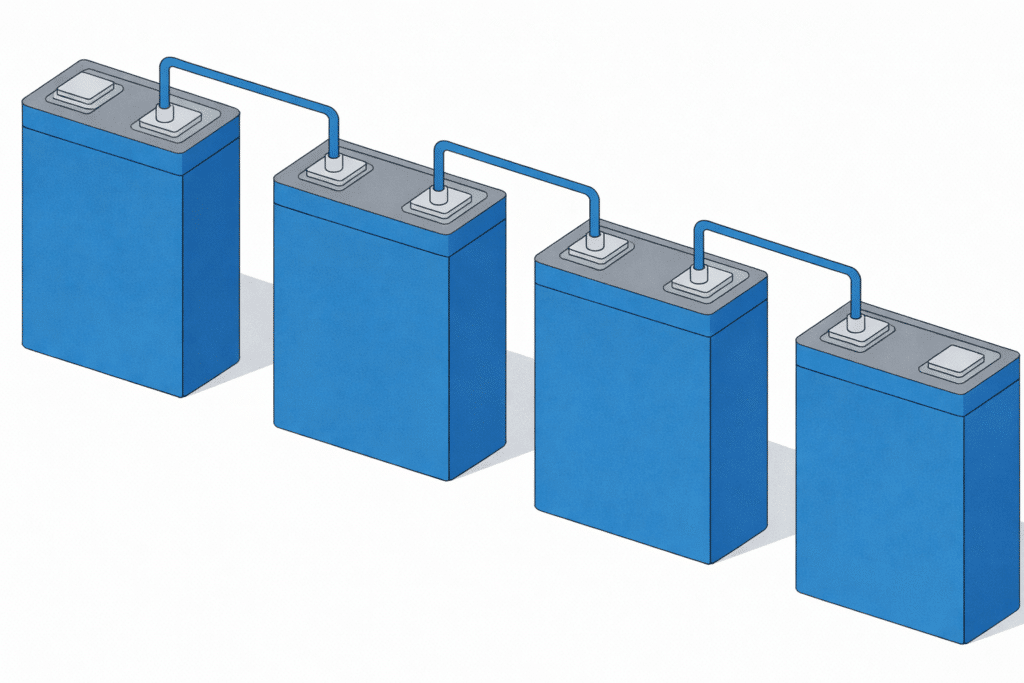
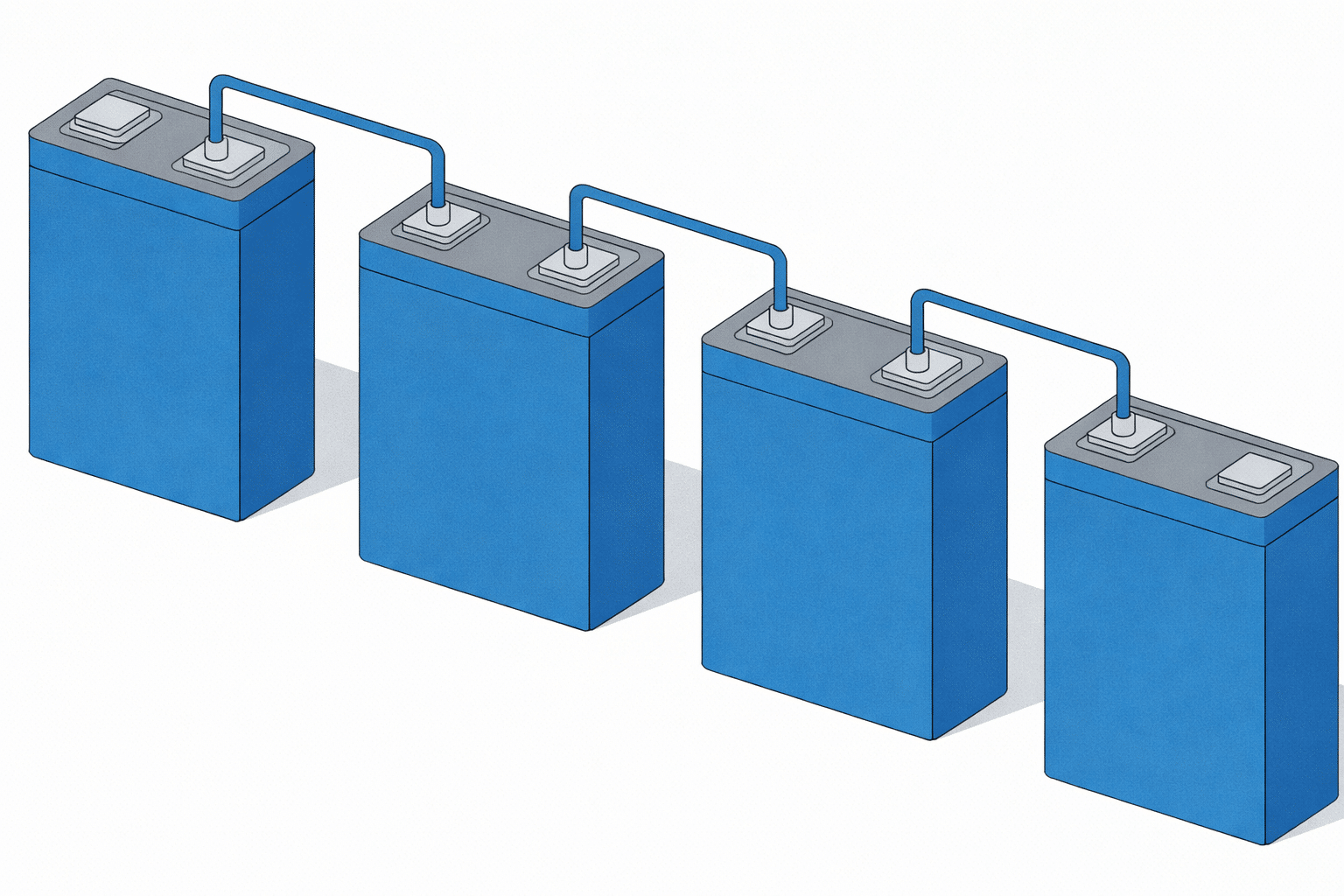
For LiFePO4 batteries, “series” means cells are connected end to end so their voltages add together. The amp-hour rating stays the same through a series string, but total pack voltage rises to match the system’s target platform.
Start with the cell
A LiFePO4 battery pack starts with the single cell. One LFP cell is usually:
- 3.2V nominal
- About 3.65V at full charge
- Often around 2.5V as a low cutoff point
The exact top and bottom limits depend on cell design, pack design, and BMS settings. That matters because pack voltage is just cell voltage multiplied by the number of cells in series.
So the engineering logic is simple:
Pack Voltage = Cell Voltage × Number of Cells in Series
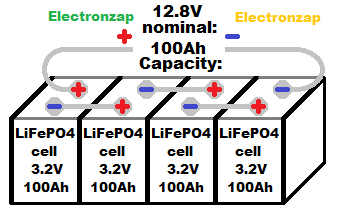
If you build a 4S pack, you connect four 3.2V cells in series:
- Nominal: 4 × 3.2V = 12.8V
- Full: 4 × 3.65V = 14.6V
That same logic scales upward for 8S, 12S, 15S, 16S, or 24S designs.
Why “series” matters more than the sticker
A case label like 12V, 24V, or 48V is useful for sales and quick system matching. But in design, troubleshooting, and charger setup, the real key is the S-count.
That is because chargers, inverters, solar charge controllers, and BMS protections all respond to actual pack voltage, not the marketing label. A “48V” LiFePO4 battery is usually a 16S pack with a nominal voltage of 51,2 В. That difference is normal, but installers need to think in cell count and voltage window.
Why this matters in the field
A pack is rarely built from series only. In real battery packs, manufacturers use:
- Series connections to build the voltage platform
- Parallel connections to raise Ah capacity and current capability
So a battery pack might be 16S1P, 16S2P, or 16S4P depending on the required capacity and cell format.
Here is a simple reference table.
| Item | Per Cell | 4S Pack | 8S Pack | 16S Pack |
|---|---|---|---|---|
| Номинальное напряжение | 3.2V | 12.8V | 25.6V | 51,2 В |
| Full charge voltage | 3.65V | 14.6V | 29.2V | 58.4V |
| Low cutoff example | 2.5V | 10.0V | 20.0V | 40.0V |
A practical rule
When you evaluate any LiFePO4 battery, ask these four questions first:
- How many cells are in series?
- What is the full-charge voltage?
- What is the allowed low-voltage cutoff?
- Does the charger or inverter support that real voltage range?
That approach prevents many expensive mistakes. It also makes it easier to compare batteries across RV, solar, marine, telecom, and traction applications.
Common LiFePO4 Battery Series: 12V (4S), 24V (8S), 36V (12S), 48V (16S)
On our production line, we see most projects cluster around a few voltage platforms, but trouble starts when buyers assume every “12V” or “48V” battery behaves the same.
The most common LiFePO4 series counts are 4S, 8S, 12S, and 16S. These correspond to roughly 12.8V, 25.6V, 38.4V, and 51.2V nominal, with higher or lower S-counts used for telecom, traction, and special equipment.
The standard voltage classes
These are the common pack series counts in the market.
| Battery Class Label | Series Count | Nominal Voltage | Full Charge Voltage | Common Uses |
|---|---|---|---|---|
| 12V class | 4S | 12.8V | 14.6V | Small RV loads, trolling motors, lighting, portable power |
| 24V class | 8S | 25.6V | 29.2V | Mid-size solar, marine, floor equipment |
| 36V class | 12S | 38.4V | 43.8V | Golf carts, light traction, some e-mobility systems |
| 48V class | 16S | 51,2 В | 58.4V | Home backup, solar ESS, telecom, larger inverters |
12V class: 4S
This is the most familiar option for buyers moving from lead-acid. The wiring is simple, and many DC appliances already use the 12V ecosystem.
But 12V systems have a limitation. To deliver higher power, they need more current. More current means:
- Thicker cables
- Larger fuses and busbars
- More voltage drop risk
- More heat in connectors
So 4S works well for light or moderate loads, but it becomes inefficient for larger inverter systems.
24V class: 8S
An 8S pack doubles the nominal voltage of 4S, so current drops for the same power level.
That often makes 24V a better fit for:
- Medium RV systems
- Small off-grid solar
- Marine auxiliary loads
- Small workshop backup systems
For many installers, 24V is a good middle ground. It keeps wiring simpler than 12V without moving all the way to 48V architecture.
36V class: 12S
12S packs are common in traction-style products such as golf carts and some utility vehicles. A 12S LiFePO4 pack is about 38.4V nominal and about 43.8V full.
This is a good example of why labels can mislead. A “36V” system is not really 36.0V nominal in LiFePO4 terms. It is a shorthand for the operating class.
48V class: 16S
This is one of the most important platforms for solar and backup storage. A 16S LiFePO4 pack is:
- 51.2V nominal
- 58.4V full charge
That is why experienced designers treat “48V LiFePO4” as a 16S system first and a 48V label second.
Other real-world series counts
Not every pack is 4S, 8S, 12S, or 16S.
You also see:
- 15S in some base station and telecom designs
- 24S in traction applications like forklifts and industrial vehicles
- Special S-counts matched to specific motor controllers or inverters
For example:
| Special Platform | Series Count | Nominal Voltage | Typical Use |
|---|---|---|---|
| Telecom/base station class | 15S | 48.0V | Some communication backup systems |
| 72V/76.8V class | 24S | 76.8V | Forklifts, mobility, traction platforms |
The best selection method
Do not pick a battery series only by habit. Pick it by the allowed voltage window of the controller, inverter, charger, or motor drive.
A simple decision rule is:
- Choose the lowest voltage platform that can deliver power efficiently
- Confirm the charger’s bulk, absorb, and float range
- Confirm the BMS high and low cutoff behavior
- Check local code and equipment requirements for your installation
That is far safer than trusting the case label alone.
LiFePO4 Cell Types Used in Battery Packs: Cylindrical, Prismatic, Pouch, Large-Format
In our engineering reviews, we often find that buyers focus on voltage first, but the cell format inside the pack can change service life, thermal behavior, and packaging options.
LiFePO4 packs can use cylindrical, prismatic, pouch, or large-format cells. The best format depends on space, current demand, mechanical support, cooling, cost target, and how the battery will be serviced in the field.
Cylindrical cells
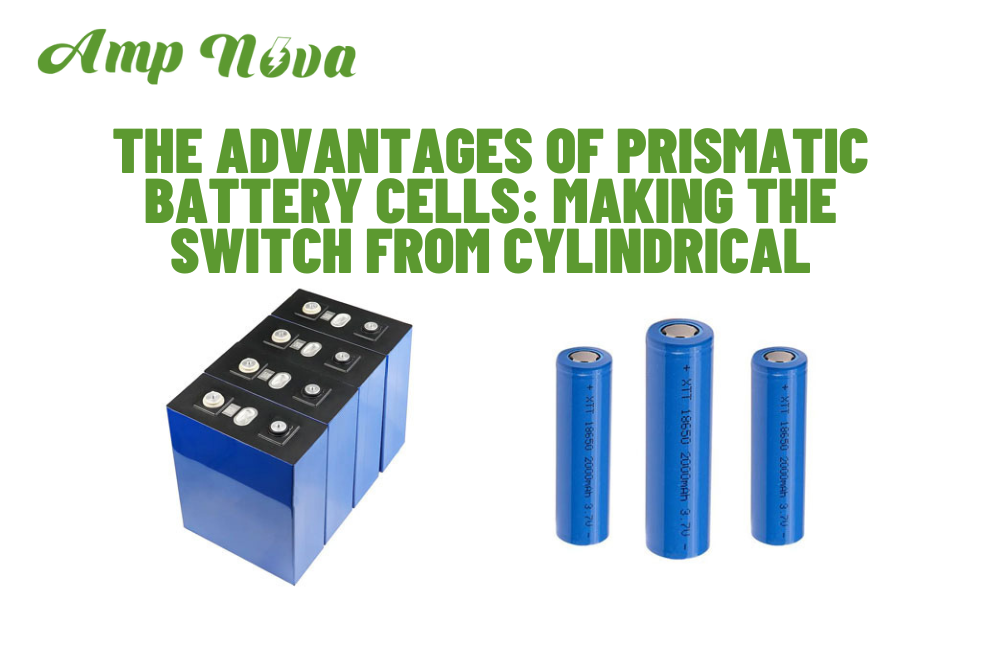
Cylindrical cells are familiar because they resemble oversized round cells used in many battery products. They are mechanically robust and can be produced at scale.
Common strengths:
- Good consistency in mass production
- Strong metal can structure
- Flexible pack arrangement for modular designs
Common trade-offs:
- More interconnections
- More weld points
- Lower packing efficiency than some prismatic layouts
These can work well in portable systems or modular packs where automated assembly matters.
Prismatic cells
Prismatic LiFePO4 cells are very common in solar storage, RV, and marine battery packs. They use a rectangular case, so they pack efficiently into battery enclosures.
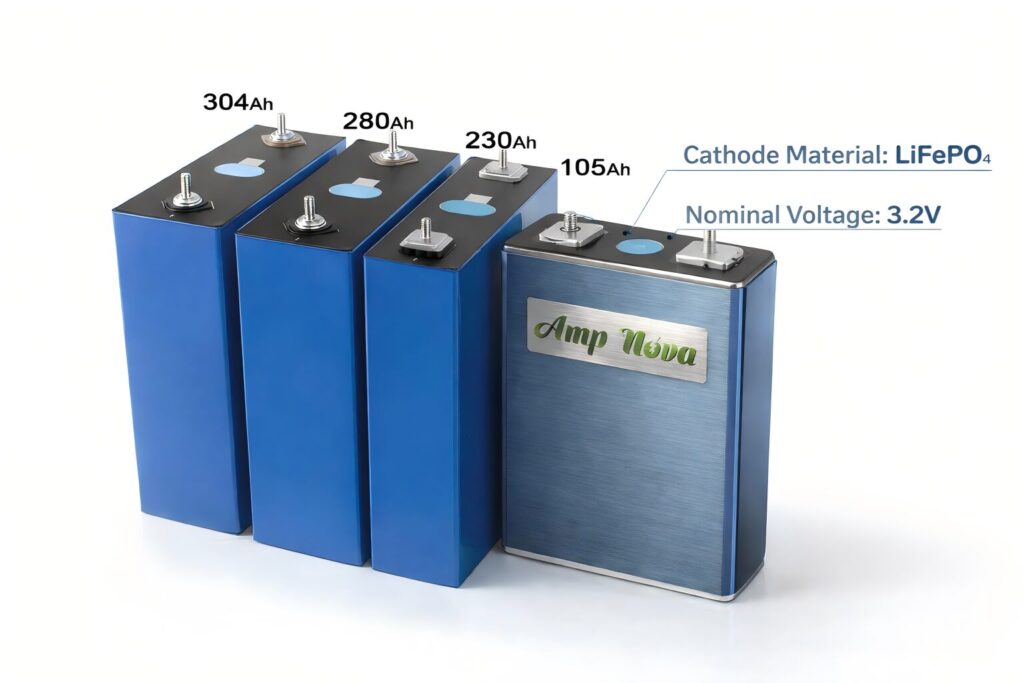
Common strengths:
- High space efficiency
- Fewer cells needed for a given capacity
- Easier pack-level assembly for many stationary systems
Common trade-offs:
- Need solid compression and support
- Swelling control matters over time
- Mechanical design quality is important
For many energy storage products, prismatic cells offer a strong balance between capacity, serviceability, and pack simplicity.
Pouch cells
Pouch cells can offer high packing efficiency and low weight. But they need good mechanical support and thermal design.
Common strengths:
- Lightweight construction
- Good space use in compact products
Common trade-offs:
- More sensitive to swelling and support issues
- More packaging complexity for long-life, rugged applications
They are less common in rugged drop-in battery designs for harsh field use, though they appear in some specialized products.
Large-format cells
Large-format LiFePO4 cells are common in high-capacity packs and traction systems. These cells reduce the number of parallel parts and interconnects.
That can help in:
- Forklifts
- Golf carts
- Base station storage
- Larger stationary ESS cabinets
But the pack must be engineered carefully because a failure in one large cell has a larger impact on the whole string.
Cell type comparison
| Тип ячейки | Main Strength | Main Trade-Off | Common Applications |
|---|---|---|---|
| Cylindrical | Robust and scalable | More interconnects | Portable packs, modular systems |
| Prismatic | Space-efficient and common in ESS | Needs compression support | Solar storage, RV, marine |
| Pouch | Light and compact | Needs strong mechanical design | Specialized compact products |
| Large-format | Fewer cells, high capacity per cell | Heavier impact per failed cell | Traction, telecom, large storage |
How cell format affects series design
Cell format does not change the basic voltage math. A 16S pack is still 16S whether it uses cylindrical or prismatic cells. But format changes:
- Pack dimensions
- Cooling strategy
- Mechanical support
- Service access
- Current path design
- Cost structure
So when you compare battery packs with the same nominal voltage, do not assume the internal build quality is equal. The same 16S label can hide very different engineering choices.
Series vs Parallel Connections: When to Increase Voltage vs Capacity
In our system sizing work, we often see a costly mistake: users increase capacity when the real problem is too much current, or they increase voltage when runtime is the real goal.
Series connections increase voltage while keeping amp-hour capacity the same. Parallel connections keep voltage the same while increasing amp-hour capacity, so the right choice depends on power level, runtime target, cable size, and equipment voltage requirements.
The core rule
Battery packs are built with both series and parallel connections.
- Ряд adds voltage
- Parallel adds capacity in Ah
If you connect four cells in series, you create a 4S voltage platform. If you then place two of those strings in parallel, the voltage stays the same, but the Ah capacity doubles.
Simple example
Suppose one LiFePO4 cell is:
- 3.2V nominal
- 100Ач
Then:
- 4S1P = 12.8V, 100Ah
- 4S2P = 12.8V, 200Ah
- 8S1P = 25.6V, 100Ah
- 8S2P = 25.6V, 200Ah
That is why battery pack design is always a combination of voltage platform and capacity target.
When increasing voltage is better
Higher voltage is usually the better move when you need more power. Why?
Because:
Power = Voltage × Current
For the same power, higher voltage means lower current.
Example:
- 1,200W at 12V needs about 100A
- 1,200W at 24V needs about 50A
- 1,200W at 48V needs about 25A
Lower current means:
- Smaller cables
- Lower heat
- Lower voltage drop
- Easier protection design
That is why serious solar and home backup systems often move toward 48V class designs.
When increasing parallel capacity is better
Parallel is useful when the voltage platform already matches the system, but you need more runtime or more current reserve.
Examples:
- Longer RV runtime overnight
- More usable kWh for solar storage
- More reserve for marine hotel loads
- More peak current support within the same voltage class
A practical comparison
| Connection Type | Voltage | Capacity (Ah) | Best Use | Common Mistake |
|---|---|---|---|---|
| More series | Increases | Stays the same | Reduce current, match inverter/controller | Exceeding equipment voltage limit |
| More parallel | Stays the same | Increases | Extend runtime, increase storage | Mixing mismatched batteries |
Decision tree
Use this quick rule:
- Is your equipment rated for a higher voltage platform?
- Yes → consider more series
- No → keep voltage fixed
- Do you need more runtime or more stored energy?
- Yes → consider more parallel
- Is current too high for cables, fuses, or busbars?
- Yes → move up in system voltage if the equipment supports it
- Are you combining battery modules?
- Use matching chemistry, capacity, voltage, and similar age
- Confirm the manufacturer permits series or parallel expansion
This is also why many modern packs are sold as complete battery systems instead of loose cells. Pack-level engineering reduces the number of variables the installer must manage.
Which LiFePO4 Series Should You Choose for RV, Solar, Marine, or Home Backup?
Our application team sees the same pattern again and again: the best battery series is rarely the one with the most popular label, but the one that fits the full voltage window of the system.
Choose LiFePO4 series count by matching the real operating voltage of your charger, inverter, controller, or motor system. For light 12V loads, 4S works well. For larger solar and backup systems, 16S is often more efficient and easier to scale.
For RV systems
A 4S battery often works well for smaller RV systems because many DC loads already run on 12V class architecture.
Good fit for 4S:
- Lighting
- Water pumps
- Small inverters
- Basic off-grid camping setups
But once inverter size climbs, 12V current climbs fast. So larger RV systems often benefit from 24V class 8S designs.
For solar systems
For small off-grid sites, 8S can be a good choice. For larger hybrid or backup solar systems, 16S 48V class is usually the stronger platform because it reduces DC current and works well with many inverters.
A good solar selection rule:
- Small loads, short cable runs → 12V class can work
- Mid-size systems → 24V class is often cleaner
- Serious whole-home or larger ESS → 48V class is usually preferred
For marine systems
Marine systems often start in 12V because of legacy equipment. But high inverter loads, long cable runs, and tight spaces can push designers toward 24V.
Salt, vibration, and enclosure constraints also matter, so mechanical design and corrosion resistance are just as important as nominal voltage.
For home backup
Home backup usually favors 16S LiFePO4. That is because larger power conversion equipment often expects a 48V class battery architecture.
This reduces current and simplifies wiring compared with building a very high-capacity 12V bank.
Think in per-cell charging targets
This point is critical. Do not rely only on the 12V, 24V, or 48V label. Think in S-count multiplied by per-cell charge targets.
For example:
- If your preferred top-of-charge target is 3.45V per cell
- Then a 16S pack target is 16 × 3.45V = 55.2V
That may be a smarter daily-use charging target than always pushing to 58.4V.
Why? Because top-of-charge voltage is a major lifespan lever. A slightly lower per-cell maximum usually trades a bit of capacity for better long-term cycle life.
Application guide
| Application | Common Best-Fit Series | Why It Fits | Watch-Out |
|---|---|---|---|
| Small RV | 4S | Matches common DC loads | High current at larger inverter sizes |
| Larger RV / small off-grid | 8S | Lower current, manageable complexity | Need compatible charger and inverter |
| Golf cart / light traction | 12S | Matches 36V-class equipment | Confirm controller voltage window |
| Home backup / larger solar | 16S | Efficient for higher power | Check full-charge and low-cutoff settings |
| Forklift / traction | 24S or application-specific | Suits higher-power drive systems | Must match motor controller exactly |
The real selection checklist
Choose series count by checking:
- Equipment voltage compatibility
- Power level and current
- Cable length and conductor size
- Expansion plan
- Charging strategy
- Local electrical and safety requirements
That is the practical way to select the right LiFePO4 series. Not by label alone, and not by copying what another system used.
Safety & Setup Tips (BMS Limits, Balancing, Mixing Batteries) + FAQs
In our quality checks, most battery failures do not come from LiFePO4 chemistry itself, but from bad integration, mismatched modules, wrong charging settings, or poor protection design.
Safe LiFePO4 setup depends on a capable BMS, matched batteries, correct charge settings, and a pack architecture that avoids uneven disconnect behavior. Integrated higher-series packs often behave better than stacking many drop-in batteries with separate internal BMS units.
Why the BMS matters
The BMS is not an accessory. It is the control layer that protects the cells from:
- Overcharge
- Overdischarge
- Overcurrent
- Short circuit
- Overtemperature
- Cell imbalance
As series count rises, BMS quality matters more because the system must monitor more cells and keep the pack within safe limits.
Why matching batteries matters
When you expand a bank, use batteries that match in:
- Chemistry
- Номинальное напряжение
- Емкость
- Charge profile
- State of charge
- Age, if possible
Mixing different batteries can cause imbalance and nuisance trips. One battery may hit high-voltage cutoff or low-voltage cutoff before the others. That weak link then controls the whole bank.
Integrated 8S or 16S pack vs stacked 12V drop-ins
This is a major real-world point. Many people build a higher-voltage bank by stacking multiple 12V drop-in batteries. It can work, but it can also create nuisance shutdowns because each battery has its own internal BMS.
If one BMS trips first:
- The string breaks
- The inverter may shut down
- Reconnect timing may not match across batteries
- Troubleshooting becomes messy
That is why one integrated 8S or 16S pack with a single pack-level BMS often gives cleaner behavior in higher-voltage systems.
Practical setup checklist
| Check Item | Why It Matters | Good Practice |
|---|---|---|
| BMS voltage limits | Prevent cell damage | Match to cell count and charger settings |
| Battery matching | Prevent imbalance | Use same model, age, and SOC where possible |
| Charge settings | Protect life and compatibility | Use per-cell targets multiplied by S-count |
| Cable and fuse sizing | Prevent heat and faults | Size for real current, not only nominal current |
| Expansion method | Prevent nuisance trips | Prefer integrated higher-voltage packs when possible |
Mixing batteries: what not to do
Avoid these common mistakes:
- Mixing LiFePO4 with lead-acid in one bank
- Mixing old and new modules casually
- Mixing different Ah ratings in one series string
- Assuming every drop-in battery supports series connection
- Using charger presets without checking actual voltage targets
Часто задаваемые вопросы
Can I connect two 12V LiFePO4 batteries in series to make 24V?
Yes, but only if the batteries are designed and approved for series use. Check the manufacturer’s limits, and make sure both batteries are matched in model, age, capacity, and state of charge.
Is a 48V LiFePO4 battery really 48V?
Usually not in nominal terms. Most “48V” LiFePO4 batteries are 16S packs with 51.2V nominal and about 58.4V full charge. The 48V label is system shorthand.
What is the difference between 12V and 4S?
For LiFePO4, they usually describe the same class. A “12V” LiFePO4 battery is commonly a 4S pack, which means four cells in series for 12.8V nominal.
Is 36V LiFePO4 common?
Yes, especially in golf carts and light traction systems. In LiFePO4 terms, 36V class is usually 12S, which is 38.4V nominal.
Why does my battery bank shut off early in a series stack?
Often one module reaches a BMS limit before the others. This is common when batteries are mismatched, imbalanced, or built as separate drop-in units that do not disconnect and reconnect in sync.
Should I always charge to 3.65V per cell?
Not always. Charging to the maximum gives full capacity, but a lower top-of-charge target can improve cycle life. Many system owners use a lower daily charge ceiling and reserve full charge for occasional balancing or maximum runtime needs.
Can I mix different Ah batteries in parallel?
It is not good practice. Even if voltage matches, different internal resistance, age, and capacity can cause uneven current sharing and stress the bank.
Is higher voltage always better?
No. Higher voltage reduces current and often improves efficiency, but the equipment must support that voltage. The correct choice is the one that matches the full operating window of the system.
Заключение
Pick LiFePO4 series by real cell count, voltage window, and BMS behavior. Match the pack to your equipment first, then optimize capacity, charge targets, and expansion method.