


Jinsi ya kuchaji betri ya lifepo4?
Ninaona makosa ya kuchaji kwenye viti vyetu vya majaribio wakati wote, na hitilafu nyingi huanza na jambo moja: mtu alitumia wasifu wa asidi-risasi au volteji isiyofaa kwa pakiti.
Ili kuchaji betri ya LiFePO4 kwa usalama, tumia chaja ya CC/CV inayolingana na LiFePO4, thibitisha kama pakiti ni 12V/24V/48V, kisha weka unyonyaji karibu na 3.45–3.65V kwa kila seli na mkondo unaofaa (mara nyingi 0.2C–0.5C). Epuka hali za asidi-risasi kama vile kusawazisha/kuondoa sulfate, na usichaji chini ya 0°C isipokuwa betri imepashwa joto au kukadiriwa.
Katika mwongozo huu, nitaonyesha mipangilio tunayotumia katika QC, jinsi ya kuithibitisha kwa kutumia mita, na jinsi ya kurekebisha matatizo ya kawaida ya kuchaji yanayohusiana na BMS.
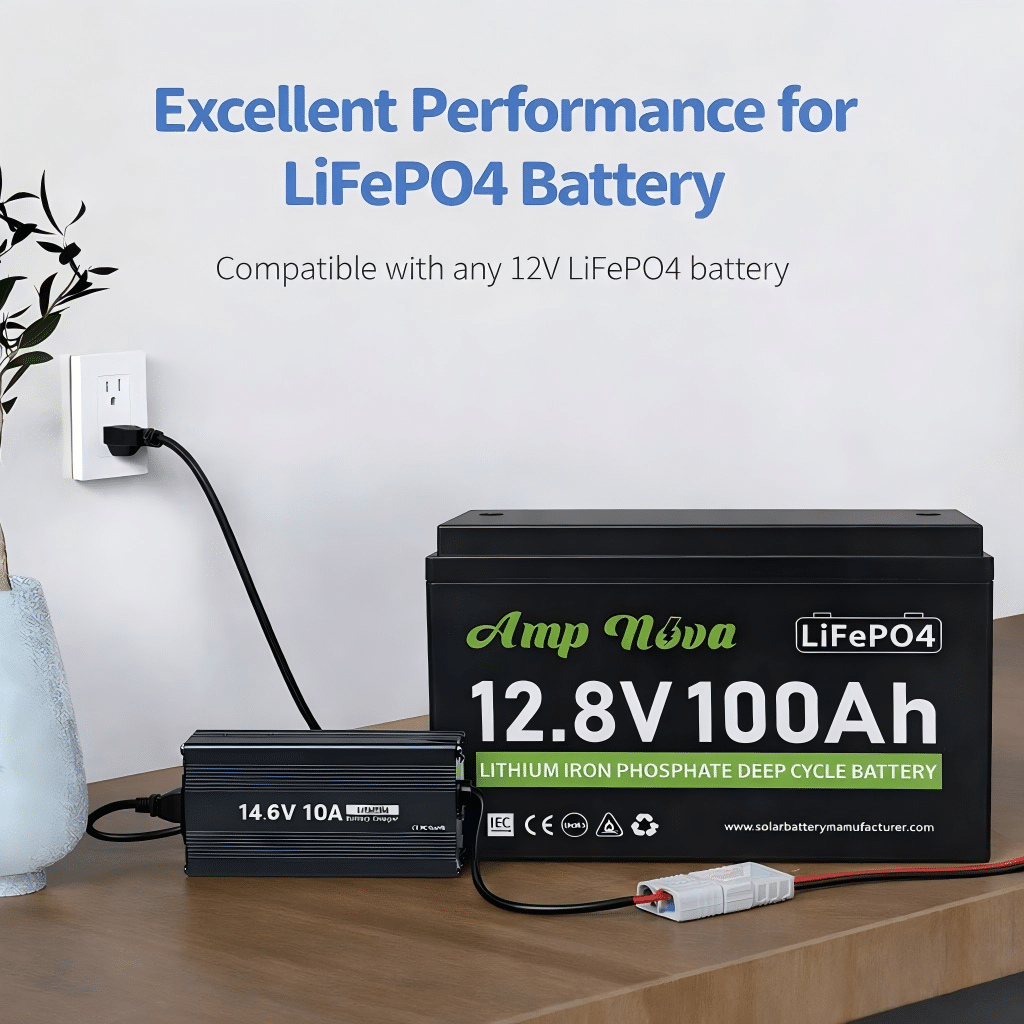
Chagua Chaja Sahihi kwa Betri ya LiFePO4
Kwenye mstari wetu wa uzalishaji, kwa kawaida tunaweza kujua ndani ya dakika chache betri ilipochajiwa na algoriti ya asidi-risasi kwa sababu kumbukumbu za BMS zinaonyesha matukio ya ulinzi na kifurushi hakionekani "kitulivu".
Chagua chaja yenye wasifu halisi wa LiFePO4 (LFP) au mipangilio ya CC/CV inayoweza kurekebishwa kikamilifu, na uthibitishe kuwa volteji ya chaja inalingana na betri yako (12V/24V/48V). Epuka vipengele vya risasi-asidi kama vile kusawazisha na kuondoa sulfuri, kwa sababu vinaweza kusukuma volteji juu sana na kusababisha kukatika kwa BMS au kufupisha maisha ya betri.
Kwa nini chaja za LiFePO4 si sawa na chaja za asidi-risasi
Kemia ya LiFePO4 hufanya kazi tofauti na asidi-risasi:
- Mkunjo wa volteji ni tambarare. Hali ya chaji haifuatilii volteji kama ilivyo safi.
- Hakuna usawa unaohitajika. LiFePO4 haitumii "kusawazisha" kama asidi-risasi iliyofurika.
- Tabia tofauti za mwisho wa malipo. LiFePO4 hufikia "kamili" wakati mkondo unapopungua katika CV, si wakati awamu ya kuelea inapoendelea milele.
Ndiyo maana ufahamu wa mtumiaji ni muhimu: chaja ya LiFePO4 na chaja ya asidi-risasi haziwezi kubadilishwaChaja ya asidi-risasi inaweza:
- kukimbia kusawazisha hatua (juu sana kwa LiFePO4),
- kukimbia mapigo ya desulfuri (huchanganya ulinzi wa BMS),
- tumia fidia ya halijoto ambayo huongeza voltage wakati wa baridi (mchanganyiko mbaya na LFP na BMS).
Mahitaji ya chini kabisa ya chaja (ninachotafuta)
Tumia orodha hii ya ukaguzi kabla ya malipo ya kwanza.
| Kipengele cha Chaja | Kwa Nini Ni Muhimu kwa LiFePO4 | Kufaulu/Kushindwa Kuangalia |
|---|---|---|
| Wasifu wa LiFePO4/LFP AU udhibiti wa CC/CV kwa mkono | Algorithm sahihi ya LFP | Menyu inaonyesha “LiFePO4” au unaweza kuweka CV/mipaka |
| Chaguo sahihi la volteji ya kawaida (12/24/48V) | Voltage isiyo sahihi inaweza kuathiri BMS mara moja | Lebo + kifurushi cha kulinganisha mipangilio |
| Hakuna kusawazisha/kuondoa sulfate (au inaweza kuzima) | Huzuia matukio ya overvoltage | Sawazisha = ZIMA |
| Muda wa kunyonya unaoweza kurekebishwa au mkondo wa mkia | Huepuka kupasha joto kwa CV bila kikomo | Unaweza kuweka kikomo cha muda au mkondo wa mwisho |
| Mkondo wa pato la juu kabisa salama | Hulinda BMS na nyaya za umeme | Kikomo cha sasa cha kuchaji betri/BMS |
| Safisha pato la DC, kanuni thabiti | Huzuia miisho katika BMS | Chapa yenye sifa nzuri; usomaji thabiti |
Thibitisha volteji ya betri kabla ya kuchaji (haiwezi kujadiliwa)
Kabla ya kuingiza chochote, thibitisha:
- Lebo ya betri: “12.8V” (seli 4), “25.6V” (seli 8), “51.2V” (seli 16) ni thamani za kawaida za nominella.
- Volti halisi ya mwisho yenye mita: Pakiti ya LiFePO4 ya “12V” mara nyingi hukaa karibu ~13V wakati wa kupumzika, lakini usidhani.
- Ukadiriaji wa matokeo ya chaja: "Chaja ya 12V" kwa asidi-risasi mara nyingi si sahihi kwa LFP.
Kanuni ya uamuzi: Kama huwezi kuthibitisha wazi kwamba kifurushi ni 12/24/48V na sehemu ya CV ya chaja yako, usichaji bado. Rekebisha utambulisho kwanza.
Dokezo mahususi kwa nishati ya jua: vidhibiti vya chaji na chaja za inverter
Katika mifumo ya jua, "chaja" inaweza kuwa:
- Kidhibiti cha chaji cha MPPT,
- chaja ya mseto ya kibadilishaji umeme,
- Chaja ya betri ya AC,
- chaja ya alternator DC-DC (simu ya mkononi/nje ya gridi).
Zote lazima ziwekwe kwa LFP. Ikiwa menyu inatoa aina za asidi-risasi pekee, tumia "Mtumiaji/Maalum" ikiwa inapatikana. Ikiwa haipatikani, badilisha vifaa.
Dokezo la usalama: Daima tumia ulinzi sahihi wa DC (fyuzi/kivunjaji, tenganisha) na ufuate misimbo ya umeme ya eneo lako na viwango vya usakinishaji.
Elewa Hatua za Kuchaji za LiFePO4 (CC/CV, Kunyonya kwa Wingi–Kuelea)
Katika maabara yetu, njia rahisi zaidi ya kuzuia matatizo ya siri ni kuchora mkunjo wa CC/CV kwenye ubao mweupe ili kila mtu aelewe maana halisi ya "wingi" na "ufyonzaji".
Chaji ya LiFePO4 ni CC/CV hasa: chaja hushikilia mkondo usiobadilika (CC) hadi betri ifikie volteji iliyowekwa, kisha hushikilia volteji isiyobadilika (CV) huku mkondo ukipungua. "Wingi" huunganisha kwenye CC, "ufyonzaji" huunganisha kwenye CV, na "kuelea" mara nyingi si lazima au huwekwa chini kwa mifumo ya kusubiri.
CC/CV kwa Kiingereza rahisi
- Mkondo wa Kawaida (CC): Chaja husukuma mkondo thabiti ndani ya betri. Voltage huongezeka polepole.
- Volti ya Kawaida (CV): Chaja hushikilia volteji katika sehemu uliyoweka (kwa mfano, ~14.2–14.6V kwa pakiti ya daraja la 12V). Mkondo hupungua kiasili betri inapojaa.
- Kukomesha ada: Wakati mkondo unapopungua hadi thamani ndogo (mkondo wa nyuma), betri huwa imejaa kikamilifu.
Kunyonya kwa Wingi–Kuelea: jinsi majina hayo yanavyoelekea kwenye LFP
Vidhibiti vingi vya nishati ya jua hutumia majina ya asidi ya risasi, lakini unaweza kuyaweka kwenye ramani:
- Wingi = Hatua ya CC. Betri hutumia mkondo mwingi unaoruhusiwa hadi ifikie voltage yako ya kunyonya.
- Kunyonya = hatua ya CV. Voltage imeshikiliwa; mkondo hupungua.
- Kuelea = volteji ya kusubiri (hiari). Mifumo mingi ya LFP huzima kuelea au kuiweka chini.
Je, LiFePO4 inahitaji kuelea?
Mara nyingi, hapana, hasa kwa nishati ya jua isiyotumia gridi ya taifa ambapo unaendesha baiskeli kila siku. Kuweka betri ya LiFePO4 kwenye 100% kwa muda mrefu kunaweza kupunguza muda wa matumizi ikilinganishwa na kuihifadhi chini kidogo.
Mwongozo wa vitendo:
- Mzunguko wa jua wa kila siku: Fikiria hakuna kuelea au kuelea chini.
- UPS/nakala rudufu ambayo lazima iwe imejaa: Tumia kuelea kwa upole (au kuongeza mara kwa mara) na ufuate mwongozo wa mtengenezaji wa betri.
Kanuni ya uamuzi: Ikiwa kidhibiti chako kinalazimisha kuelea, weka kuelea chini ya ufyonzaji na uendelee kuwa na muda wa kunyonya kwa njia ya kihafidhina.
Jinsi ya kumaliza kunyonya kwa usafi (bila kupika kupita kiasi)
Unataka muda wa kutosha wa CV kusawazisha pakiti na kumaliza kuchaji, lakini si muda mrefu sana kiasi kwamba inakaa kwenye volteji ya juu kwa saa nyingi.
Mbinu za kawaida za kukomesha:
- Mkondo wa mkia: Maliza CV wakati mkondo unashuka hadi (mfano) 0.05C kwa 0.1C.
- Kikomo cha muda: Maliza CV baada ya (mfano) Dakika 15–60, kulingana na ukubwa wa mfumo na mzunguko wa kila siku.
- Kulingana na BMS: Baadhi ya mifumo husimama kwenye mawimbi ya BMS; bado huweka mipaka ya kidhibiti chenye akili timamu.
Ikiwa chaja yako haiwezi kufanya mkondo wa nyuma, tumia kifuniko cha muda.
Hatua gani za kuepuka zenye asidi ya risasi
Disable these for LiFePO4:
- Equalize
- Desulfation / pulse repair
- Aggressive temperature compensation that increases voltage in cold weather
These functions are designed for lead-acid failure modes, not LFP.
Mipangilio ya Volti ya Kuchaji Inayopendekezwa (12V / 24V / 48V)
When we commission packs for customers, most “charging issues” disappear after we match per-cell targets to the correct series count and then re-check voltage at the battery terminals under load.
Set LiFePO4 charging voltage by cells-in-series: typical absorption is about 3.45–3.65V per cell, with float disabled or set around 3.35–3.40V per cell if needed. For common systems, that’s roughly 14.2–14.6V (12V), 28.4–29.2V (24V), and 56.8–58.4V (48V), then verify at the battery terminals.
Step 1: Identify your pack configuration (do not guess)
Common LiFePO4 nominal systems:
- 12V-class: 4 cells in series (4S), nominal ~12.8V
- 24V-class: 8S, nominal ~25.6V
- 48V-class: 16S, nominal ~51.2V
Some products use different series counts, especially in specialty equipment. Always check the label/datasheet.
Step 2: Use conservative default voltages, then fine-tune
If you do not have the exact datasheet, start conservative and adjust only if you have a clear reason (and the BMS allows it).
| System (Typical) | Bulk/Absorption (CV Setpoint) | Float (Optional) | Notes |
|---|---|---|---|
| 12V LiFePO4 (4S) | 14.2–14.6V | 13.4–13.6V or OFF | Avoid equalize; many systems run OFF float |
| 24V LiFePO4 (8S) | 28.4–29.2V | 26.8–27.2V or OFF | Confirm controller truly set to 24V |
| 48V LiFePO4 (16S) | 56.8–58.4V | 53.6–54.4V or OFF | Watch voltage drop on long DC runs |
Muhimu: Some LiFePO4 brands recommend the lower end of these ranges for longevity, while others allow the higher end to support balancing. The correct answer is the datasheet. If you have it, follow it.
Step 3: Set absorption time (or tail current)
Good starting points (general guidance):
- Absorption time: 15–45 minutes for daily-cycled solar systems
- Tail current end: 0.05C–0.1C (if supported)
If you frequently hit BMS high-voltage cutoff near the end, reduce absorption voltage slightly, reduce absorption time, or improve cell balancing (see troubleshooting).
Step 4: Measure voltage at the battery terminals (not at the controller)
Voltage drop can trick you:
- Controller shows 14.4V, but battery terminals only see 14.0V due to wiring loss.
- Or the controller senses at its terminals, overshoots at the battery if sensing is wrong.
Field check:
- Charge at a steady current.
- Measure voltage at battery terminals.
- Compare to the setpoint.
- If difference is big, fix wiring: shorten runs, increase cable size, tighten lugs, check breakers.
Step 5: Never use lead-acid equalization voltages
Equalize voltages can exceed safe LFP per-cell limits quickly. That is a common reason packs trip BMS or age early.
Jinsi ya Kuweka Mkondo Sahihi wa Chaji (Kiwango cha C) kwa Maisha Marefu ya Betri
In our QA cycling rigs, we see the same pattern: lower heat and lower peak current usually produce nicer capacity retention over time, even when the voltage settings are perfect.
Set charge current using C-rate: Current (A) = C-rate × Capacity (Ah). For longer life, many LiFePO4 systems charge around 0.2C–0.5C when temperature and time allow. Higher currents can work if the battery and BMS allow it, but they add heat and can increase stress.
What C-rate means (one line)
- 1C means charging at a current equal to the battery’s Ah rating (100Ah → 100A).
- 0.5C means half that (100Ah → 50A).
- 0.2C means one-fifth (100Ah → 20A).
Practical targets (longevity vs speed)
Use these as starting points unless your battery datasheet says otherwise:
- Longest-life bias: 0.2C–0.3C
- Balanced: 0.3C–0.5C
- Fast charge (only if allowed): up to 1C for some designs, but confirm BMS and temperature
Quick chart (examples)
| Battery Capacity (Ah) | 0.2C (A) | 0.5C (A) | 1C (A) |
|---|---|---|---|
| 50Ah | 10A | 25A | 50A |
| 100Ah | 20A | 50A | 100A |
| 200Ah | 40A | 100A | 200A |
| 280Ah | 56A | 140A | 280A |
Limits you must check before choosing current
- Battery/BMS max charge current: This is a hard limit.
- Charger/controller limit: Do not assume it matches your battery.
- Cable and connector rating: Heat at lugs is a real failure mode.
- Temperature: Cold and hot both reduce safe charging headroom.
Kanuni ya uamuzi: If you do not know the BMS max charge current, start at 0.2C and increase only after verifying stable temperature and no BMS protect events.
Solar controller sizing tip
If your PV array can deliver more than your chosen charge current, you can:
- cap charge current in the controller,
- or accept that peak sun might push current higher.
For battery health, current limiting is often worth it.
Alternator charging note (vehicles, mobile solar)
If you charge from an alternator, use a DC-DC charger with an LFP profile. Direct alternator-to-LFP can create unstable behavior and overheated wiring.
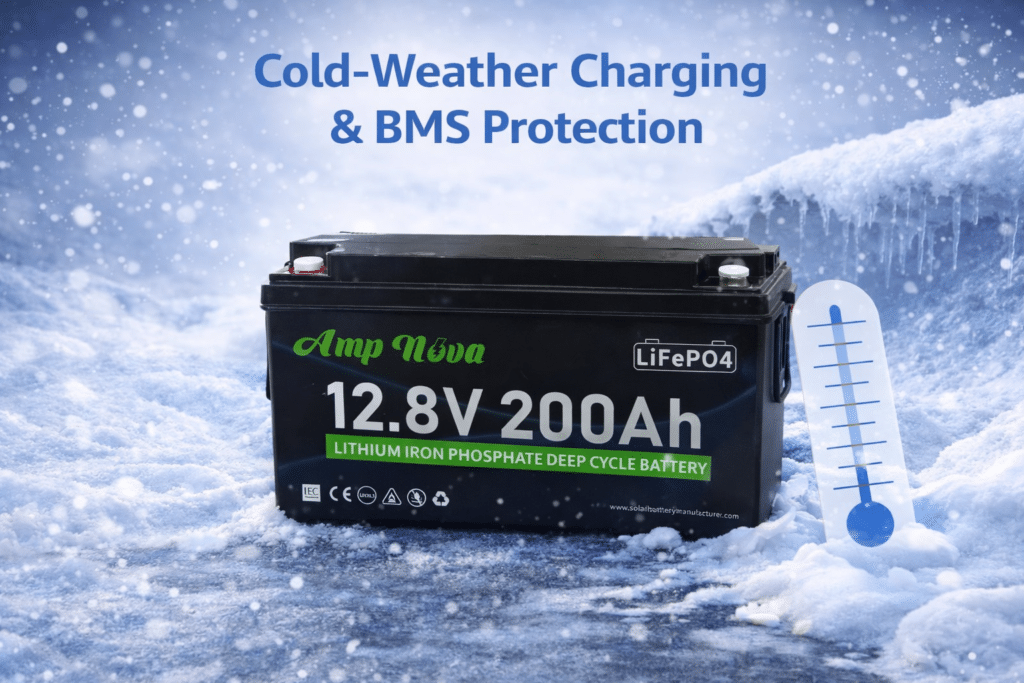
Kiwango cha Halijoto Salama cha Kuchaji (Kuchaji kwa Hali ya Hewa Baridi na Ulinzi wa BMS)
We receive many “battery won’t charge” tickets in winter, and most are not charger failures. The BMS is usually doing its job and blocking cold charging to protect the cells.
Most LiFePO4 batteries should be charged above 0°C (32°F) and below about 45°C (113°F), unless the battery is explicitly rated for colder charging. Charging below freezing can plate lithium and cause permanent damage, so many BMS units cut off charge current until the cells warm up.
Why cold charging is risky
Below freezing, the cell chemistry cannot accept charge normally. If you force it, you can cause lithium plating, which is a permanent damage mechanism. That is why BMS low-temp charge cutoffs exist.
What BMS protection looks like in the field
Common symptoms:
- Charger shows “on,” but current is near zero.
- Battery app/log shows “charge MOSFET off” or “low temp protect.”
- The system charges again later in the day when the enclosure warms.
Cold-weather charging playbook (simple and reliable)
- Warm the battery first.
- Use a battery heater pad with thermostat.
- Put batteries in an insulated enclosure.
- Charge later in the day.
- In solar, schedule heavy charging after the sun warms the enclosure.
- Reduce charge current in cold conditions.
- Even above 0°C, lower current can reduce stress.
- Avoid temperature compensation that increases voltage.
- Many controllers assume lead-acid behavior. Disable or neutralize temp comp for LFP.
- Watch condensation and connections.
- Cold metal + warm air can create moisture. Keep terminals clean and protected.
Hot-weather notes
High temperatures also matter:
- Heat accelerates aging.
- High current + high ambient temperature can push internal temps up.
If the enclosure is hot, consider:
- lower charge current,
- better airflow,
- shading for outdoor battery cabinets.
Safety note: Do not place heaters or batteries near flammables. Use proper fusing and wiring practices and follow local electrical codes.
Kutatua Matatizo ya Kuchaji ya LiFePO4 (Kukatika kwa BMS, Kutofikia Kamili, Volti Kupita Kiasi)
On our support bench, we solve most charging issues by doing three measurements in order: battery terminal voltage, charge current, and temperature. Then we match them to the charger settings.
When LiFePO4 charging fails, first confirm pack voltage (12/24/48V) and charger setpoints, then measure voltage at the battery terminals during charge. BMS cutoffs are commonly caused by low temperature, overvoltage from wrong profiles, or overcurrent. “Not full” problems often come from conservative voltages, short absorption time, or voltage drop in cables.
Fast diagnostic flow (5 minutes)
- Identify the pack: 12/24/48V and capacity (Ah).
- Read charger settings: absorption voltage, float voltage, absorption time, current limit.
- Measure at the battery terminals while charging:
- Voltage
- Current (clamp meter is ideal)
- Battery temperature (or BMS reported temp)
- Check the BMS status: any active protection flags?
- Inspect wiring: loose lugs, undersized cables, hot connectors, blown fuses.
Common problems and fixes (matrix)
| Symptom | Likely Cause | What to Measure | Fix |
|---|---|---|---|
| Charger shows charging, but 0A into battery | BMS low-temp cutoff | Battery/BMS temp | Warm battery; add heater; charge above 0°C |
| Charging stops near the top | Absorption voltage too high or equalize on | Terminal voltage at cutoff | Disable equalize; lower absorption voltage slightly |
| Battery never reaches “full” | Absorption voltage too low or absorption too short | Terminal voltage and taper current | Raise absorption within safe range; increase absorption time or tail-current logic |
| Charger reports full too early | Termination set by time too short | Absorption timer and current | Increase absorption time; use tail current if available |
| Overvoltage alarms | Wrong profile (lead-acid), alternator spikes, controller bug | Charger output waveform and peak V | Use LFP profile; add DC-DC charger; update firmware if applicable |
| Controller shows correct V, battery sees less | Voltage drop in wiring | V at controller vs V at battery | Increase cable size; shorten run; tighten/replace lugs |
| BMS trips on overcurrent | Charger current too high | Charge current at start of CC | Reduce current limit; use smaller charger or controller cap |
Mini decision tree (simple)
- If charge current is zero:
- Check joto → if below 0°C, warm the battery.
- If temperature is OK, check BMS flags and charger enable.
- If charge current is high but stops abruptly near full:
- Check if equalize/desulfate is enabled.
- Check absorption voltage vs recommended range.
- If it never hits full:
- Check battery terminal voltage under charge.
- If low, fix wiring drop or raise absorption within safe limits.
- If voltage is fine but SOC is low, check BMS calibration/app settings.
A note about “BMS reset”
Some BMS units require:
- removing the charger and loads for a short period,
- or pressing a physical reset,
- or using an app command.
Do not repeatedly “hammer” the battery with reconnect cycles. Fix the root cause (often temperature or wrong voltage settings).
Verify you are not mixing 12V/24V/48V settings
This is the second user insight, and it causes real damage:
- A 24V charger on a 12V pack will push voltage too high fast.
- A 12V charger on a 24V pack will never reach absorption.
Rule: Battery nominal voltage and charger nominal voltage must match. Then set absorption/float correctly.
Maswali Yanayoulizwa Mara kwa Mara
Can I charge a LiFePO4 battery with a lead-acid charger?
Sometimes it will “work,” but it is risky. Lead-acid chargers may run equalize or desulfation modes that can overvoltage an LFP pack and trip the BMS. Use an LFP profile charger or a configurable CC/CV charger with equalize disabled.
What is the best charging voltage for a 12V LiFePO4 battery?
Many 12V-class (4S) LiFePO4 packs charge around 14.2–14.6V in absorption, depending on the battery’s datasheet and balancing needs. Start conservative if you are unsure, then verify at the battery terminals during charging.
Should I float a LiFePO4 battery?
Often you can disable float for daily-cycled systems. If you need standby readiness (backup/UPS), use a low float setting recommended by the battery maker. Avoid keeping the battery at 100% for long periods if you want maximum long-term life.
How long does it take to charge LiFePO4?
Time depends on charge current and battery size. A rough estimate is: hours ≈ (Ah to replace) ÷ (charge amps), plus some extra time for CV taper. Higher current reduces time but can increase heat and stress.
Can I charge LiFePO4 in freezing weather?
Most LiFePO4 batteries should not be charged below 0°C unless the battery is specifically rated for it or has internal heating. Many BMS units block charging when cells are too cold. Warm the battery first.
Why does my battery stop charging near the top?
Common causes include absorption voltage set too high, equalize mode enabled, or the BMS protecting against cell overvoltage. Measure terminal voltage at cutoff and reduce absorption voltage slightly, and ensure equalize/desulfate are disabled.
Why does my LiFePO4 battery not reach 100% SOC?
SOC estimation can drift, and some chargers stop absorption too early. Confirm terminal voltage reaches the absorption setpoint and that current tapers. If needed, extend absorption slightly or enable a tail-current termination method.
Do I need a special charger for solar MPPT?
You need an MPPT controller that supports LiFePO4 settings or a custom profile. Program absorption/float and current limits correctly, and disable lead-acid-only features like equalization and temperature compensation that raises voltage.
Is fast charging (1C) bad for LiFePO4?
Not always, if the battery and BMS allow it and temperature is controlled. But for longer life, many systems charge at 0.2C–0.5C when time allows. Heat and high voltage time are the real enemies.
Hitimisho
Charge LiFePO4 with an LFP CC/CV profile, confirm pack voltage first, set conservative voltages and C-rate, and respect temperature limits. Next step: verify your settings with a meter at the battery terminals.