


Observo o mesmo problema em nossa bancada de testes de baterias: as pessoas esperam automaticamente uma duração de "10 anos", depois utilizam alta corrente em ambientes quentes e se perguntam por que a autonomia diminui.
As baterias LiFePO4 geralmente oferecem de 8 a 15 anos de serviço confiável, e muitas são classificadas para aproximadamente 3.000 a 6.000 ciclos, atingindo uma capacidade de cerca de 80% quando usadas corretamente. A vida útil real depende da profundidade de descarga, da temperatura, da corrente de carga/descarga, dos hábitos de armazenamento e da proteção do BMS (Sistema de Gerenciamento de Bateria), portanto, o uso diário moderado pode prolongar a vida útil muito mais do que o uso intenso para redução de picos de demanda.
Então, vamos traduzir "anos versus ciclos" em uso real de energia solar e fornecer regras práticas que protejam a vida útil do sistema.
O que é uma bateria LiFePO4 (fosfato de ferro-lítio)?
Em nossa linha de produção, tratamos as baterias de LiFePO4 de forma diferente das baterias de lítio "genéricas", pois, embora sua composição química seja estável, elas ainda são resistentes ao calor e a usos indevidos.
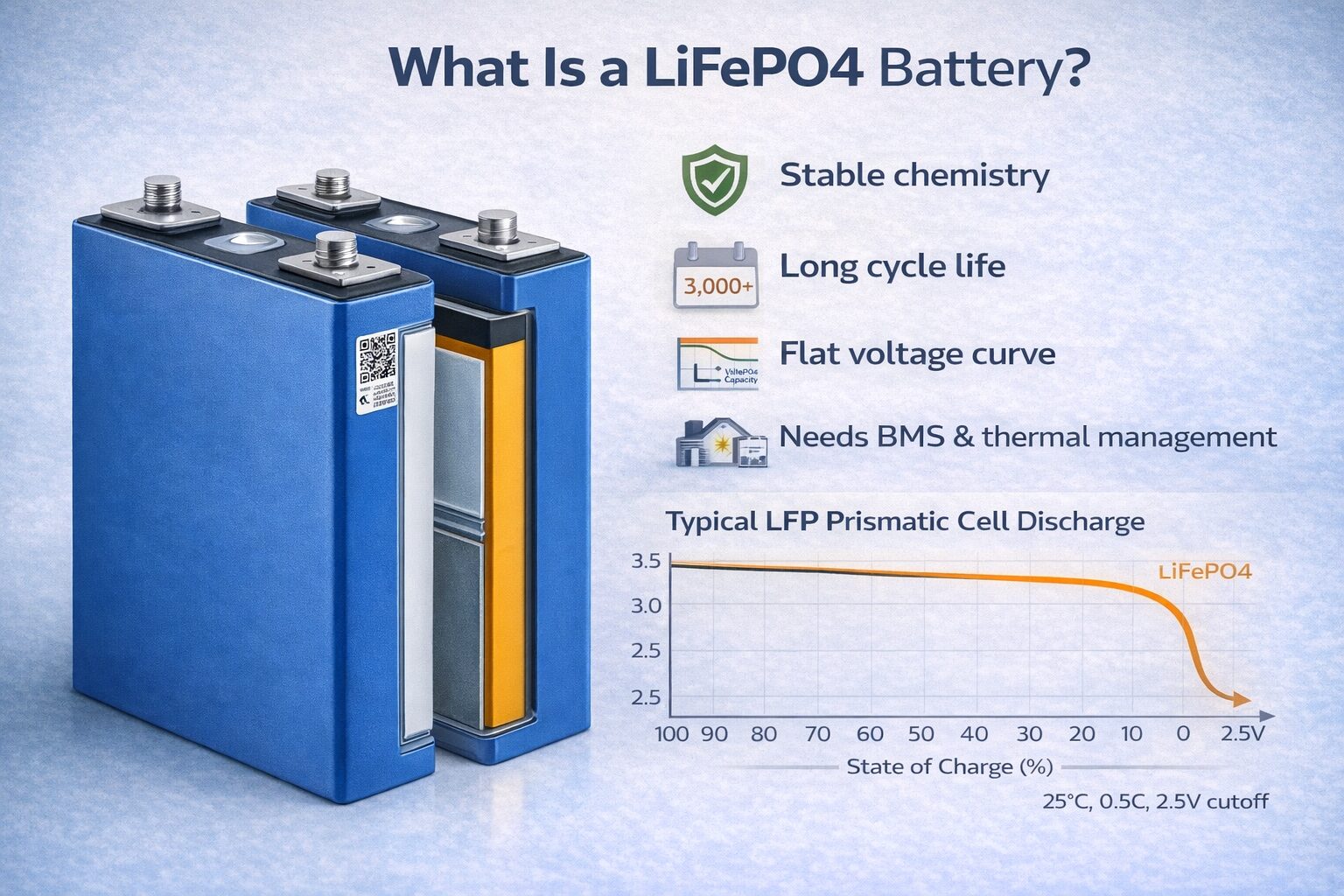
Uma bateria LiFePO4 (LFP) é uma bateria de íon-lítio que utiliza fosfato de ferro-lítio como material catódico. Ela é conhecida por sua forte estabilidade térmica, longa vida útil e uma curva de tensão de descarga relativamente plana. Em sistemas de armazenamento de energia solar, a LFP é popular porque pode fornecer muitos ciclos com desempenho consistente quando protegida por um sistema de gerenciamento de bateria (BMS) adequado e um perfil de carregamento otimizado.
O que diferencia o LFP em sistemas solares reais?
A tecnologia LFP ainda é de "íon-lítio", mas se comporta de maneira diferente das baterias NMC/NCA comuns usadas em muitos veículos elétricos e eletrônicos de consumo.
- Segurança e estabilidade: O LFP é amplamente considerado mais termicamente estável do que muitas outras composições químicas de lítio. Isso não significa "sem risco". Significa que você ainda precisa projetar considerando fusão, isolamento e ventilação, mas com maior margem de segurança.
- Longo ciclo de vida: Muitos produtos LFP convencionais são comercializados com base em "milhares de ciclos" até um limite de capacidade definido, geralmente em torno de Estado de saúde (SoH) 80%Na prática, é por isso que a LFP domina as discussões sobre armazenamento de energia solar residencial e comercial/industrial.
- Comportamento da tensão: LFP tem um curva de tensão relativamente plana em grande parte de sua faixa de operação. Isso é bom para inversores, mas também significa A voltagem é um indicador de combustível fraco. na faixa intermediária. A estimativa do SoC (estado de carga) geralmente requer contagem de Coulomb e calibração periódica.
- Dependência do BMS: Os pacotes LFP dependem muito de um Sistema de gerenciamento de bateria (BMS) Para evitar sobrecarga, descarga excessiva e abuso de temperatura. Ao solucionar problemas de falhas iniciais, a lógica deficiente do BMS ou o posicionamento inadequado dos sensores são causas comuns.
Dois tipos de “vida”: calendário versus ciclo
As pessoas discutem sobre "quantos anos" porque misturam dois mecanismos:
- Vida no calendário: Envelhecimento que acontece com o tempo, mesmo que você quase não ande de bicicleta.
- Ciclo de vida: Envelhecimento devido ao fluxo de carga/descarga, especialmente ciclos profundos e alta corrente.
Na energia solar, você geralmente obtém ambos ao mesmo tempo. É por isso que "anos" e "ciclos" devem ser convertidos em seu ciclo de trabalho real.
Referências úteis (lista não exaustiva): O blog da EcoFlow aborda a estrutura da vida útil das baterias LFP (anos versus manutenção), a Anern fala sobre o DoD (Domínio de Defesa) e as expectativas de ciclo, a Renogy publica orientações sobre temperatura, o artigo de visão geral da LithiumHub e a Battery University discute hábitos de longevidade.
Fontes: EcoFlow (https://www.ecoflow.com/uk/blog/lifepo4-battery-life), Renogy (https://www.renogy.com/blogs/general-solar/how-long-do-lifepo4-batteries-last), LithiumHub (https://lithiumhub.com/lifepo4-battery-life-how-long-do-they-really-last/), Universidade da Bateria (https://www.batteryuniversity.com/article/bu-808-how-to-prolong-lithium-based-batteries/)
Qual a vida útil das baterias LiFePO4 (anos ou ciclos de carga)?
Nos nossos testes de controle de qualidade, consigo fazer com que a mesma bateria "dure 10 anos" ou "pareça velha em 3 anos" apenas alterando a corrente, a temperatura e a amplitude da oscilação.
A maioria das baterias LiFePO4 de qualidade oferece aproximadamente 8 a 15 anos de serviço confiável, e muitas são classificadas em torno de 3.000 a 6.000 ciclos, atingindo uma capacidade de cerca de 80% em condições moderadas. Os anos descrevem o envelhecimento por tempo de uso, enquanto os ciclos descrevem o envelhecimento por fluxo de trabalho. A vida útil real é melhor prevista pelos Ciclos Completos Equivalentes (EFCs), além da temperatura e da intensidade de operação da bateria no dia a dia.
Anos versus ciclos: como traduzir classificações para sua utilização
A maioria das campanhas de marketing fornece um número de ciclo (ou um número de ano). A resposta honesta é: você precisa de ambos.
- Classificação do ciclo geralmente é definido para um limite de capacidade, comumente ~80% de capacidade original (SoH). Isso é um ponto de referência, não um precipício.
- Anos Depende do SoC de armazenamento, da temperatura média e da frequência com que o sistema utiliza um SoC elevado.
Ciclos Completos Equivalentes (ECF): o “medidor da verdade” mais simples
Um "ciclo" não se resume a "uma única vez que você conecta o aparelho". No uso real de energia solar, os ciclos parciais se acumulam.
- Duas oscilações 50% ≈ 1 EFC
- Quatro oscilações 25% ≈ 1 EFC
É por isso que pessoas que "usam apenas um pouco todos os dias" ainda podem acumular uma contagem de ciclos significativa ao longo do tempo. Uma maneira prática de registrar a vida útil é através dos dados de consumo de energia (EFC) do seu inversor/sistema de gerenciamento de energia (EMS).
Sua observação — 6000 ciclos ≈ 10 anos — tem condições.
Sua percepção é exatamente como modelamos isso internamente:
- Se um pacote LFP puder entregar ~6000 ciclosE você faz Aproximadamente 1 EFC por dia, isso é ~6000 dias.
- 6000 ÷ 365 = 16,44 anos (matemática apenas sobre ciclos ideais).
- No mundo real, o envelhecimento causado pelo calendário e as condições não ideais reduzem isso, então “Mais de 10 anos é realista."Sob condições de operação cuidadosas" é uma afirmação justa e prática.
Mas suas “premissas” importam muito:
- descarga de ~0,2C (baixo estresse, baixo calor).
- ~25°C temperatura de operação (ponto ideal).
- Evitar temperaturas extremas e picos elevados na taxa C.
Uma tabela prática de "tradução da vida" (use como planejamento, não como garantia).
Abaixo, seguem exemplos de traduções que ajudam instaladores e empresas de certificação energética (EPCs) a alinhar expectativas. Não se tratam de promessas universais, mas sim de ferramentas para auxiliar na tomada de decisões.
| Usar padrão (exemplo) | Banda média do Departamento de Defesa | Valor aproximado de EFC por dia | Estresse térmico/taxa C | O que você normalmente vê |
|---|---|---|---|---|
| Autoconsumo suave | 25–75% na maioria dos dias | 0,3–0,7 | Baixa (fria, <0,3°C típico) | Longa vida útil, desbotamento lento. |
| Balanço total diário | 10–90% ou 0–100% | 0,8–1,0 | Moderado se estiver frio | Boa vida se mantida em paz |
| Corte de pico com alta potência | Oscilações amplas + picos de alta potência (kW) | 0,7–1,2 | Alto (calor + corrente) | Desgaste mais rápido, aumento de resistência mais precoce |
| Em espera somente de backup | Ciclismo raro | ~0,0–0,1 | Envelhecimento predominantemente por calendário. | A duração em anos depende do estado de carga (SoC) do armazenamento e do calor. |
A verdade sobre o “fim da vida útil do 80%” que a maioria dos compradores ignora.
O fim da vida útil em 80% SoH não significa que a bateria seja inútil.
- Se sua aplicação tiver margem de segurança, você poderá continuar usando-a por anos.
- A matilha fica “menor”. Ela não “morre” instantaneamente.
- A pergunta certa passa a ser: "Ainda atende às minhas necessidades de autonomia e potência com uma queda de tensão aceitável?"
O que afeta a vida útil da bateria LiFePO4? (Profundidade de descarga, temperatura, carregamento, armazenamento)
Ao realizarmos análises de falhas, a causa raiz raramente é uma "química inadequada". Geralmente, são o calor, a alta corrente ou o controle de carga deficiente que aceleram silenciosamente o envelhecimento.
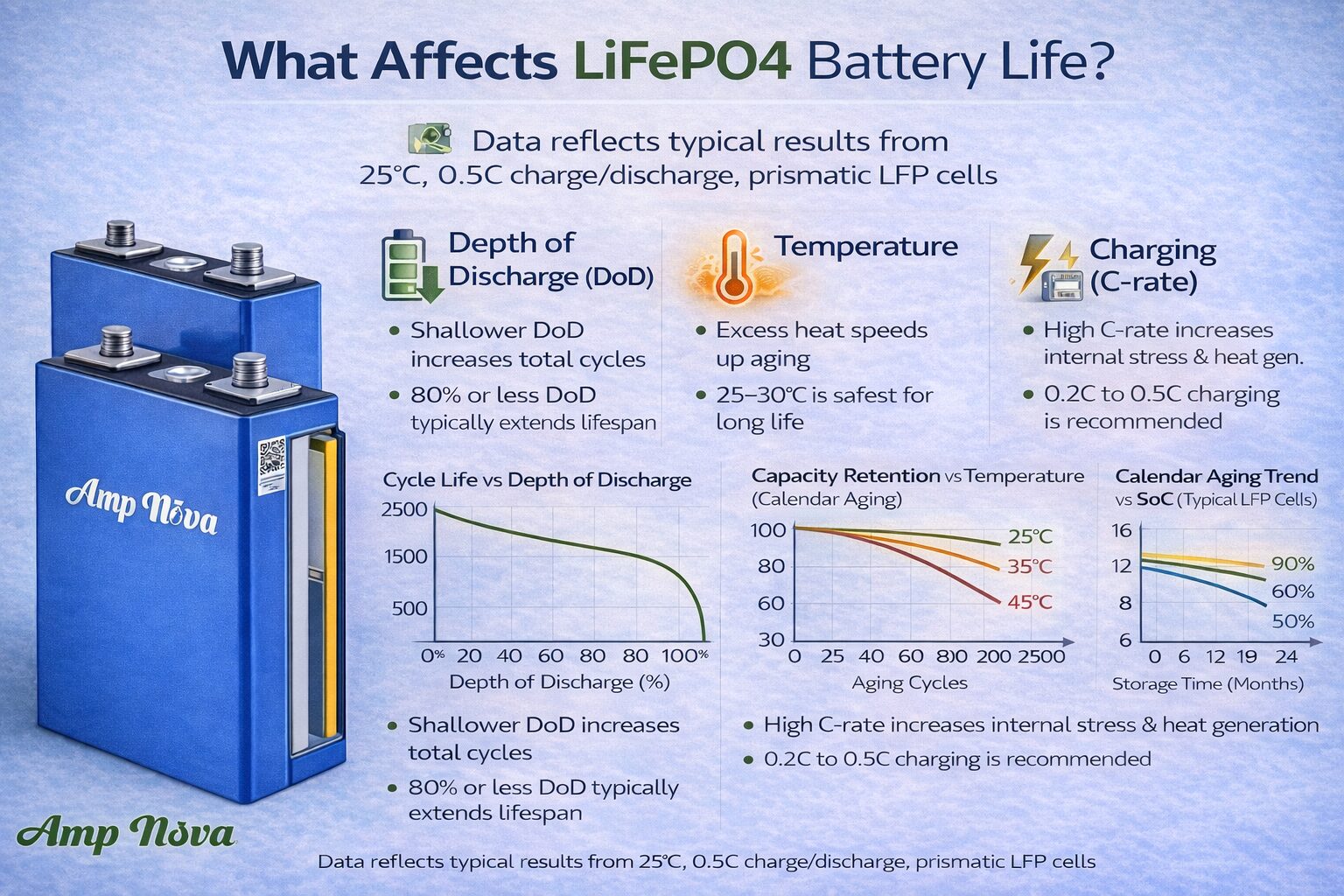
A vida útil das baterias LiFePO4 é afetada principalmente pela profundidade de descarga (DoD), exposição à temperatura, corrente de carga/descarga (taxa C) e pela forma como a bateria é carregada e armazenada. Ciclos menos profundos geralmente resultam em um maior número total de ciclos, o calor acelera o envelhecimento tanto por tempo quanto por ciclos, e picos de alta taxa C aumentam o estresse e o aquecimento interno. Limites de carga adequados, um estado de carga (SoC) de armazenamento correto e um sistema de gerenciamento de bateria (BMS) confiável reduzem os danos causados por sobretensão, subtensão e variações de temperatura.
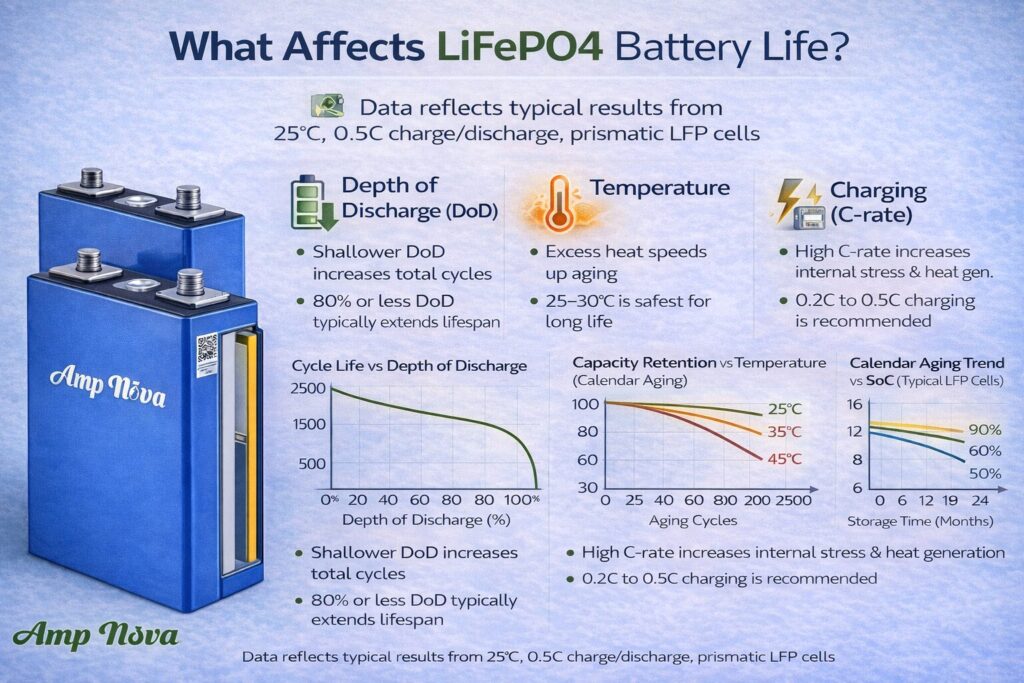
1) Profundidade de Descarga (DoD): o maior fator que influencia a vida útil do ciclo de carga e descarga.
DoD é "quanto você retira" a cada ciclo.
- Ciclagem profunda (próximo ao nível de dano 100%) é conveniente, mas consome ciclos.
- Ciclagem menos profunda (como a do DoD do 50%) geralmente resulta em um número significativamente maior de ciclos ao longo da vida útil.
Regra de decisão que utilizamos no dimensionamento do sistema:
Se o cliente deseja máxima durabilidade e tem capacidade suficiente, projete a operação diária para funcionar em um banda SoC intermediária e reserve ciclos profundos para eventos raros.
2) Temperatura: o maior fator que influencia a vida (e um assassino silencioso)
A temperatura provoca reações secundárias e também aumenta as perdas por resistência interna.
- Calor intenso por longos períodos É prejudicial mesmo que o ciclismo seja leve.
- Carregamento em condições de frio Pode ser arriscado para compostos químicos de lítio se o BMS não os bloquear.
Realidade no campo: "Funciona no verão" não é o mesmo que "vai durar no verão". Coloque a embalagem em um local fresco. Evite guardá-la em garagens quentes e sem ventilação.
3) Taxa C e picos de corrente: energia não é gratuita
Your note about 0.2C is a key point installers often ignore.
- A pack can be rated for high current, but that does not mean high current is “healthy.”
- High current increases heat and accelerates wear.
- Even short peaks matter if they repeat daily.
Quick C-rate refresher:
C-rate = current divided by capacity.
Example: 100Ah pack at 20A discharge = 0.2C.
4) Charging profile and BMS quality: where “paper specs” become real life
Most longevity guidance points to charging discipline and protection electronics.
- Correct voltage limits protect cells from overcharge stress.
- Low-voltage cutoffs prevent harmful deep discharge.
- Temperature sensors must be accurate and placed well.
- Balancing behavior matters for long-term pack uniformity.
5) Storage habits: don’t park it full forever
If a solar system frequently tops to 100% and then sits full for long hours, that can increase calendar aging.
A practical longevity approach many technicians use:
- Operate mid-SoC most days.
- Charge to 100% only occasionally to allow balancing (if the BMS balances at high SoC).
Factor impact table (installer-ready)
Use this table when you are troubleshooting why a “10-year” battery looks tired early.
| Factor | What It Changes | Typical Symptom | What To Do |
|---|---|---|---|
| High DoD daily | Faster cycle aging | Capacity fades sooner | Increase usable capacity or tighten SoC window |
| High average temperature | Faster calendar + cycle aging | Rising resistance, more voltage sag | Improve ventilation, move location, shade enclosure |
| High C-rate peaks | Heat + stress | Early BMS cutoffs under load | Reduce peak power, parallel strings, bigger inverter match |
| Always at 100% SoC | Calendar aging | Slow but steady capacity loss | Add “top-off schedule” instead of constant float |
| Poor BMS sensing/cutoffs | Safety + longevity risk | Random shutdowns, imbalance | Validate BMS specs, wiring, and sensor placement |
Como prolongar a vida útil da bateria LiFePO4: Melhores práticas de carregamento e manutenção
On our line, we can spot “future returns” by looking at how customers plan to charge and where they mount the pack. Most lifespan wins come from boring discipline.
To extend LiFePO4 lifespan, keep temperature moderate, avoid routine 0–100% cycling, reduce high C-rate peaks, and follow a LiFePO4-specific charging profile with a capable BMS. Operate in a mid-state-of-charge band most days, charge to 100% only occasionally for balancing if needed, and verify performance with periodic capacity checks and voltage-sag trends instead of relying on age alone.
Charging settings: practical targets (always confirm with your vendor datasheet)
I avoid “one-size-fits-all” voltages because pack design differs (cell count, BMS behavior, inverter settings). Still, the strategy is consistent.
Strategy first:
- Prefer daily mid-SoC operation over daily full.
- Use gentle current when possible (your 0.2C point is excellent).
- Avoid long hot soaks at high SoC.
A simple operating playbook (solar-friendly)
Daily (most days):
- Set an SoC window like 25–75% or 30–80% if your system supports it.
- Limit charge/discharge power so typical current is comfortably below continuous rating.
Weekly or monthly (maintenance):
- Charge to full occasionally if your BMS balances at high SoC.
- Let the pack rest briefly near top-of-charge if balancing needs time (only if the vendor recommends it).
Seasonal:
- In hot seasons, tighten power limits and improve ventilation.
- In cold seasons, ensure the BMS blocks charging below safe temperature.
Maintenance checks you can actually do
You do not need a lab. You need consistent logs.
- Runtime trend: Same load, same conditions, shorter runtime = capacity loss or rising resistance.
- Voltage sag trend: Under the same load, deeper sag over time often indicates resistance rise.
- BMS logs: Look for high-temperature events, high-current events, and low-voltage cutoffs.
Storage rules (for warehouses and spare packs)
If a pack will sit unused:
- Store at a moderate SoC (often around 40–60% as general guidance).
- Keep it cool and dry.
- Check SoC periodically and top up if it drifts too low.
Charging & care checklist table (field-ready)
| Goal | What To Set / Do | Why It Helps | Common Mistake |
|---|---|---|---|
| Reduce cycle wear | Use a mid-SoC band most days | Fewer deep swings | Daily 0–100% because “it’s there” |
| Reduce heat stress | Improve airflow, avoid hot enclosures | Heat accelerates aging | Mounting near inverters/chargers with no ventilation |
| Reduce current stress | Keep typical discharge near ~0.2–0.5C if feasible | Less heating and stress | Sizing the battery just to meet peak kW |
| Ensure balancing | Full charge occasionally (per BMS design) | Prevents drift and weak cells | Never reaching balance point, leading to early cutoffs |
| Prevent abuse | Use correct BMS + correct charge profile | Avoid over/under voltage and cold charging | Using lead-acid charger settings on LFP |
Helpful reading: Battery University’s longevity habits overview is a good mental model for “lower stress = longer life,” even though implementation details vary by pack.
Source: Battery University (https://www.batteryuniversity.com/article/bu-808-how-to-prolong-lithium-based-batteries/)
Baterias LiFePO4 versus baterias de chumbo-ácido: qual dura mais (e por quê)?
In our incoming inspection of failed batteries, lead-acid usually dies from sulfation and deep discharge history, while LFP usually “ages out” more gracefully if the controls are right.
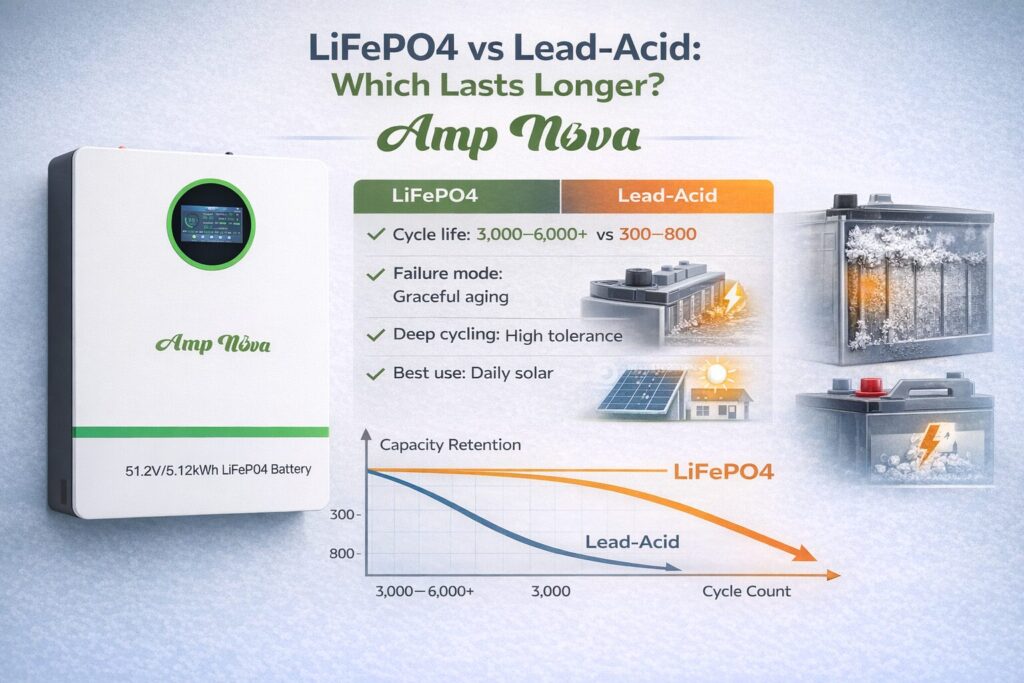
LiFePO4 batteries typically last longer than lead-acid because they tolerate far more cycles before meaningful capacity loss and they avoid common lead-acid failure modes like sulfation from partial state of charge. Lead-acid life drops sharply with deep cycling and poor recharge habits, while LFP can handle frequent cycling with less damage when protected by a BMS and charged correctly. The real advantage shows up in daily-cycling solar use and high uptime requirements.
Why lead-acid often underperforms in solar cycling
Lead-acid can be cost-effective, but it is sensitive to real-world behavior:
- Partial state of charge operation often causes sulfation.
- Deep discharge hurts more and recovers less.
- Recharge time and absorption behavior matter a lot.
If you see a site that “never fully recharges” (cloudy climates, undersized PV), lead-acid tends to suffer earlier.
Why LFP tends to win on lifecycle service
LFP advantages in typical solar duty:
- Strong cycle resilience when operated moderately.
- Less maintenance compared to flooded lead-acid.
- More stable performance across much of the discharge curve.
But LFP is not magic:
- A weak BMS can cause nuisance trips or imbalance.
- High C-rate + heat can erase the expected life advantage.
Ownership view: define “lasts longer”
There are two “longer” questions:
1) Service life: how long until it no longer meets the load requirement.
2) Economic life: how long until replacement is the cheaper option.
LFP often wins on service life for daily cycling. Lead-acid can still win in low-cycle backup roles where upfront cost dominates.
Comparison table (practical, not salesy)
| Category | LiFePO4 (LFP) | Lead-Acid (AGM/Flooded/Gel) | What It Means for Solar |
|---|---|---|---|
| Typical cycling tolerance | High (often “thousands of cycles” marketed to ~80% SoH) | Lower (especially with deep daily cycling) | LFP usually fits daily self-consumption better |
| Sensitivity to partial recharge | Lower | Higher (sulfation risk) | Cloudy sites can punish lead-acid |
| Weight/space | Lower | Higher | Rack density and install labor change |
| Manutenção | Low (mostly monitoring) | Higher for flooded (watering, equalize) | O&M burden differs |
| Protection electronics | Needs BMS | Simpler, but still needs proper charging | Wrong settings hurt both, differently |
Note: Specific cycle numbers vary widely by brand, DoD, and temperature. Treat any single number as a planning input, not a promise.
Sinais de que uma bateria LiFePO4 está perto do fim de sua vida útil (perda de capacidade, redução do tempo de execução, desligamentos do BMS)
When customers send packs back, the earliest sign is rarely “won’t turn on.” It is usually shorter runtime and more shutdowns under the same load because resistance has crept up.
A LiFePO4 battery nearing end-of-life usually shows measurable capacity loss, reduced runtime under the same load, increased voltage sag, and more frequent BMS cutoffs during peaks. End-of-life is often defined around 80% of original capacity, but the pack may remain usable if the application can tolerate lower energy and power. The most reliable way to judge health is periodic capacity testing plus trend tracking of sag and cutoff events, not age alone.
1) Capacity loss: the cleanest indicator (if you measure it correctly)
Capacity checks do not need to be fancy, but they must be repeatable.
Simple field method (controlled discharge test):
- Start at a known SoC (ideally full, if safe and recommended).
- Discharge at a steady, moderate load (avoid extreme current).
- Record delivered kWh (or Ah) until a defined cutoff.
- Repeat every 6–12 months under similar temperature.
If delivered energy drops significantly compared to baseline, you have true capacity fade.
2) Runtime drop and voltage sag: what operators notice first
Two packs can show similar capacity at rest but behave differently under load.
- Rising internal resistance increases voltage sag.
- The inverter hits low-voltage thresholds earlier.
- You get less usable energy at real power levels.
Look for: same load, earlier cutoff, or more frequent inverter low-voltage alarms.
3) BMS cutoffs and “random” shutdowns: often power-related, not energy-related
Frequent BMS trips can mean:
- Load peaks exceed the pack’s safe current.
- Temperature rises and triggers protection.
- Cell imbalance causes one cell to hit limits early.
This is why a pack can show “fine SoC” but still shut down when a pump starts.
4) Cell imbalance: the hidden runtime thief
Imbalance can show up as:
- Early high-voltage cutoff near the top (one cell hits limit).
- Early low-voltage cutoff near the bottom (one cell sags first).
If balancing only happens near full, and you never charge near full, imbalance can grow quietly.
End-of-life does not mean “end of use”
A pack at ~80% SoH may still be perfectly fine for:
- Smaller loads
- Shorter backup windows
- Non-critical applications
But it may no longer fit:
- Peak shaving targets
- Long outage backup promises
- High surge loads
Diagnostic table: symptom → likely cause → action
| Symptom | Likely Cause | What To Check First | Typical Fix |
|---|---|---|---|
| Runtime shorter at same load | Capacity fade or higher resistance | Repeatable discharge test, kWh logs | Adjust expectations, add capacity, reduce load |
| More voltage sag under load | Rising internal resistance | Compare sag at same kW and temp | Reduce peak current, improve cooling, parallel packs |
| Frequent BMS cutoffs on peaks | Overcurrent or heat | BMS event logs, cable size, connector heat | Limit power, fix wiring, increase capacity |
| Early cutoff near full | Imbalance or charge settings | Cell delta at top, charger voltage | Occasional balance charge, verify charge profile |
| Early cutoff near empty | Imbalance or deep discharge | Cell delta at low SoC, inverter LVD | Raise low cutoff, avoid deep cycling |
Perguntas frequentes
How many years will a LiFePO4 battery last in a solar system?
Many quality packs deliver roughly 8–15 years of dependable service in real solar use. Life depends on daily DoD, average temperature, and how hard you push current. Gentle cycling and cool operation can extend life beyond typical expectations.
Is 6000 cycles really equal to 10 years?
It can be, under the right conditions. If you average about 1 EFC per day, 6000 cycles is about 16.4 years on cycle count alone. Real systems lose some life to calendar aging, heat, and high current, so 10+ years is realistic when you keep stress low (for example ~0.2C and ~25°C).
What does “80% capacity” end-of-life mean?
It means the pack has about 80% of its original usable energy under the test conditions. It is not a sudden failure point. Many users keep running LFP batteries beyond that if the reduced runtime still meets the application needs.
Does charging to 100% every day hurt LiFePO4?
It can increase calendar aging if the pack sits at high SoC for long periods, especially in heat. A practical strategy is operating in a mid-SoC band most days and charging to 100% only occasionally for balancing, depending on how the BMS balances.
What’s the best DoD for long LiFePO4 life?
Shallower cycling typically yields more total cycles. Many systems target something like 20–80% or 25–75% for daily operation when capacity allows. You still need to meet backup requirements, so the “best” band is the one that protects life without breaking the project’s energy promise.
Do high C-rate loads really shorten lifespan?
Yes, often because high current increases heating and stress. Even if the pack is rated for the current, routinely pushing near limits can accelerate resistance growth and cause earlier BMS cutoffs. If you want long life, design so typical operation is comfortably below the continuous rating.
Why does my LiFePO4 battery shut off even when SoC looks high?
SoC can look fine while the BMS trips on overcurrent, low voltage under load, temperatura, or cell imbalance. The fastest way to diagnose is to read BMS event logs and compare voltage sag under a known load.
How do I know if my battery is degrading: capacity or just settings?
Trend both: delivered kWh on a controlled discharge test (capacity) and voltage sag at the same kW load (resistance). If capacity is stable but sag worsens, you may have rising resistance, wiring losses, or power peaks that are too aggressive.
Can I use a lead-acid charger on LiFePO4?
Usually not safely as a default. LFP requires a LiFePO4-appropriate charging profile and protection logic. Always follow the battery vendor’s recommended voltage limits and confirm your inverter/charger has an LFP mode or configurable setpoints.
Conclusão
LiFePO4 lasts longest when it stays cool, avoids high C-rate stress, and cycles in a mid-SoC band. Set proper charge limits and track EFCs to protect ROI.